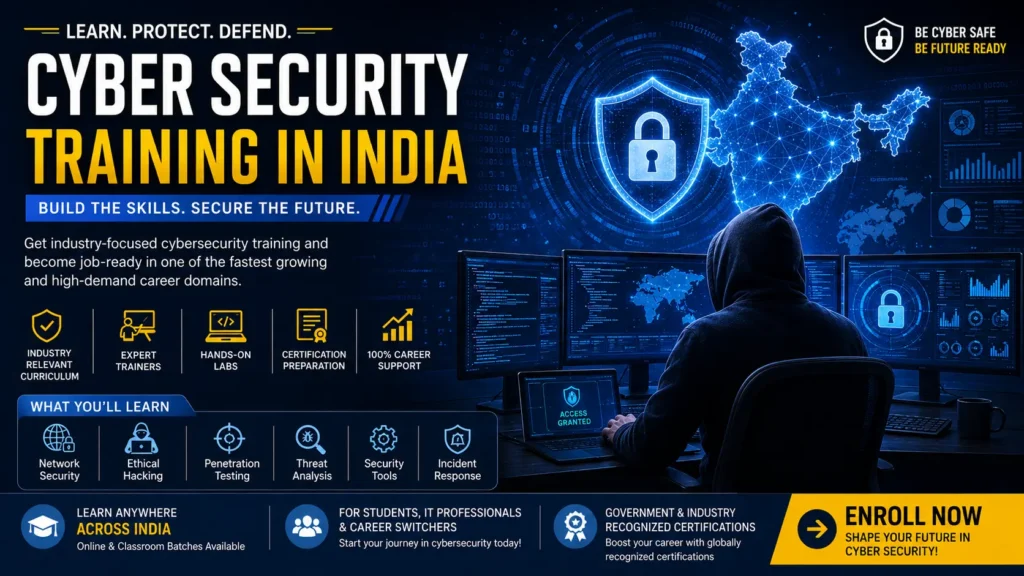
Every 39 seconds, somewhere in the world, a cyberattack takes place. In India, that threat isn’t a distant statistic — it’s showing up in hospital records held for ransom, bank customers losing money to phishing links, and startups scrambling after a data leak makes the evening news. As the country’s digital economy expands, so does its exposure, and that exposure has created one of the most talked-about skill gaps in Indian tech: a shortage of trained cyber security professionals.
If you’ve been searching for cyber security course in India, you’ve probably noticed the market is crowded. Every institute claims to be “the best,” every course promises “100% placement,” and every landing page looks nearly identical. This guide cuts through that noise. We’ll walk through why cyber security has become such an urgent hiring priority in India, what a genuinely useful training program should include, which certifications actually matter to recruiters, and how to separate a training provider that builds real skills from one that’s just selling a certificate.
Why Cyber Security Has Become India’s Most Urgent Tech Skill
India’s digital transformation has been remarkably fast. UPI transactions, cloud-first enterprises, remote work, and government digitisation initiatives have all pushed more sensitive data online than ever before. That same speed has left a lot of gaps for attackers to exploit.
Industry skilling studies have repeatedly pointed to a shortfall of well over a hundred thousand trained security professionals in the country, even as recruitment for the role keeps climbing while several other tech categories have cooled down. Financial fraud alone accounts for the overwhelming majority of cybercrime complaints filed in India over the last few years, and metro cities with the heaviest digital adoption — Bengaluru, Hyderabad, and Mumbai among them — consistently report the highest volumes of incidents.
For job seekers, this translates into something rare in today’s tech job market: genuine, sustained demand. Analysts, SOC engineers, penetration testers, cloud security specialists, and GRC (governance, risk, and compliance) professionals are being hired across banking, healthcare, IT services, e-commerce, and government sectors — often faster than institutes can produce qualified candidates.
Who Should Take Cyber Security course
One of the most common misconceptions is that cyber security is only for people with a computer science degree or years of coding experience. In reality, a well-structured cyber security course welcomes a much wider range of learners:
- Fresh graduates from IT, computer science, or even non-technical backgrounds who want a focused, career-first entry point into tech.
- Network engineers looking to move from routing and switching into security-focused roles like firewall administration or SOC operations.
- System administrators who already understand infrastructure and want to specialise in defending it.
- Working IT professionals aiming for a lateral move into security analyst, penetration tester, or compliance roles.
- Career switchers from unrelated fields who are drawn to the job stability and long-term growth cyber security offers.
The common thread isn’t a specific degree — it’s curiosity, patience with detail, and a willingness to practice hands-on rather than memorise theory.
What a Genuinely Useful Cyber Security Training Program Covers
This is where most comparisons between institutes get shallow. Nearly every provider lists similar buzzwords — ethical hacking, penetration testing, cloud security — but the depth and delivery of each topic is what actually determines whether a graduate is job-ready. A solid curriculum should walk through:
1. Networking and Security Fundamentals
Before anyone can defend a system, they need to understand how it communicates. This includes TCP/IP fundamentals, OSI layers, firewalls, VPNs, and secure network design — the building blocks that every later module depends on. If firewalls and network defense particularly interest you, our dedicated firewall training in India goes several levels deeper into Cisco, Palo Alto, and Check Point configurations.
2. Ethical Hacking and Penetration Testing
Learners should get comfortable identifying vulnerabilities the way an attacker would: reconnaissance, scanning, exploitation, and reporting. Tools like Kali Linux, Nmap, Metasploit, Burp Suite, and Wireshark should be part of daily practice, not a one-time demo.
3. Vulnerability Assessment and Web Application Security
Web apps remain one of the most exploited attack surfaces. Training should cover OWASP Top 10 vulnerabilities, secure coding awareness, and practical exercises on test environments that simulate real-world web application flaws.
4. SOC Operations and SIEM Tools
Security Operations Center skills — log analysis, threat detection, and incident response using SIEM platforms — are among the fastest-growing hiring categories in India right now. Exposure to tools like Splunk or IBM QRadar gives learners a serious edge.
5. Cloud Security Basics
With most Indian enterprises now running workloads on AWS, Azure, or GCP, understanding cloud security fundamentals — identity and access management, shared responsibility models, and cloud misconfiguration risks — has become non-negotiable.
6. Digital Forensics and Threat Intelligence
Investigating a breach after it happens is a distinct skill set: evidence collection, log correlation, malware analysis, and building a timeline of an attack.
7. Compliance, Risk, and Security Frameworks
Frameworks like ISO 27001 and basic risk management principles matter more as learners target mid-level and leadership-track roles later in their careers.
Certifications That Actually Matter to Indian Employers
Certifications are often the deciding factor between two similarly experienced candidates. A few consistently carry weight with Indian recruiters:
- CompTIA Security+ — widely regarded as the standard entry point into cybersecurity, covering network security, threat management, cryptography, and risk assessment. It’s frequently the first certification recommended for beginners because it validates a broad, vendor-neutral foundation. Our CompTIA Security+ training in India is built specifically around this exam blueprint, with a Bangalore-based batch option through our CompTIA Security+ training in Bangalore program.
- CEH (Certified Ethical Hacker) — the go-to credential for anyone targeting penetration testing or ethical hacking roles, focused heavily on offensive security techniques.
- CCIE Security — a far more advanced, Cisco-specific certification aimed at experienced network and security professionals who want to specialise in enterprise-grade security architecture. Professionals already comfortable with networking fundamentals can explore our CCIE Security training course to go further into enterprise security design.
- CISSP, CISA, and CISM — mid-to-senior level certifications that matter more once a professional has a few years of hands-on experience and is moving toward security management or audit roles.
The right starting point depends entirely on where you are in your career. Someone with zero background typically benefits most from starting with networking fundamentals and CompTIA Security+, then progressing toward CEH and specialised tracks like SOC analysis or cloud security.
What Sets a Strong Training Institute Apart From the Crowd
Search “best cyber security training institute in India” and you’ll find dozens of providers — global certification bodies, university-affiliated programs, MOOC platforms, and regional institutes — all making similar claims. Having looked closely at what’s currently ranking and what students actually ask about afterward, three gaps show up again and again:
Most listings describe course topics but not how they’re taught. A syllabus that lists “penetration testing” tells you nothing about whether you’ll spend ten hours in a lab attacking a simulated environment or ten minutes watching a slide. The delivery format — live labs versus recorded theory — is usually the biggest predictor of whether a graduate can actually perform the job.
Placement claims are rarely backed by specifics. “100% placement assistance” appears on almost every competing page, but very few explain what that assistance actually includes — mock interviews, resume building, direct referrals, or simply access to a job portal.
Certification prep and job-readiness are often treated as separate things. Many programs are excellent at getting someone through an exam but don’t necessarily prepare them to walk into a SOC or a pentest engagement on day one. The strongest programs treat the certification as a milestone within a broader, practice-heavy curriculum — not the entire goal.
This is the exact gap Networkers Champ was built to close. Based in Bangalore — a city that itself reports some of the highest volumes of cyber incidents in India, and not coincidentally, one of its largest security hiring hubs — our cyber security course in Bangalore is structured around daily lab practice rather than passive lectures. Students work inside cyber ranges and simulated attack environments, analyse real vulnerabilities, and build the muscle memory that interviews and job assessments actually test for.
Our trainers bring direct industry experience in ethical hacking, network security, and penetration testing, and the course structure — interactive theory, hands-on labs, weekly assignments, mini-projects, and final evaluations — mirrors how security teams actually operate day to day. Learners preparing for CEH, CompTIA Security+, or more advanced tracks like CCIE Security get certification-focused preparation alongside practical skills in vulnerability scanning, secure system configuration, cloud security basics, digital forensics, and security automation. Placement support includes interview preparation, resume workshops, and dedicated career guidance rather than a generic job board link.
Career Paths and Growth After Cyber Security Training
A completed cyber security certification opens the door to a wide range of entry points, and most professionals specialise further as they gain experience:
- SOC Analyst — monitoring networks, triaging alerts, and responding to incidents in real time.
- Penetration Tester / Ethical Hacker — simulating attacks to uncover vulnerabilities before real attackers do.
- Network Security Engineer — designing and maintaining firewalls, VPNs, and secure network architecture.
- Cloud Security Engineer — securing workloads and identities across AWS, Azure, or GCP environments.
- Digital Forensics Analyst — investigating breaches and reconstructing attack timelines.
- GRC / Compliance Analyst — managing risk assessments, audits, and regulatory compliance.
Salaries vary significantly by role, experience, and city, but cyber security consistently ranks among the higher-paying specialisations within Indian IT — and unlike many tech roles facing automation pressure, demand for human judgement in security continues to climb rather than shrink. If you want a deeper, step-by-step breakdown of this journey, our guide on how to become a Cyber Security Analyst and our Cyber Security Career 2026 roadmap both walk through this in more detail.
Industries Actively Hiring Cyber Security Talent in India
Cyber security hiring in India is no longer concentrated in IT services alone. Nearly every sector handling digital data now maintains a dedicated security function:
- Banking, Financial Services, and Insurance (BFSI) — one of the largest employers of security analysts and GRC professionals, given the volume of financial fraud and the strict regulatory oversight banks operate under.
- Healthcare — hospitals and health-tech platforms increasingly store sensitive patient data digitally, making them frequent ransomware targets and driving demand for dedicated security teams.
- E-commerce and fintech — high transaction volumes and customer data at scale make these platforms priority targets, and priority hirers of penetration testers and cloud security engineers.
- IT services and MNC captives — global companies with India-based delivery centers routinely staff SOC teams, security engineering roles, and compliance functions locally.
- Government and public sector — digitisation initiatives across state and central government departments have created a steady stream of security-focused roles, often requiring specific certifications as a baseline.
This spread across sectors is part of why cyber security remains one of the more resilient career paths in Indian tech — a slowdown in one industry rarely affects hiring demand across the board.
Choosing Between Online, Classroom, and Hybrid Training
Format matters almost as much as curriculum, and it’s worth being honest with yourself about how you learn best before choosing one.
Classroom training works well for learners who benefit from in-person accountability, immediate doubt-clearing, and structured lab access on dedicated infrastructure. It’s often the strongest option for hands-on modules like penetration testing, where watching a trainer walk through an exploit live makes a real difference.
Online training offers flexibility for working professionals who can’t commit to fixed hours, but the quality gap between providers is wide. The key question to ask is whether “online” means live, instructor-led sessions with real lab access, or a library of pre-recorded videos with no interaction — the latter rarely produces job-ready skills on its own.
Hybrid models, where theory is delivered flexibly but labs and mentoring happen live, tend to offer the best balance for most learners — combining the convenience of remote learning with the accountability of direct instructor access.
How to Choose the Right Cyber Security Course for You
Before enrolling anywhere, it’s worth asking a training provider a few direct questions:
- How much of the course is hands-on lab work versus theory? Ask for a sample lab exercise, not just a syllabus PDF.
- Which certifications does the curriculum map to, and how current is the exam version covered?
- What does placement assistance actually include — mock interviews, resume reviews, direct company referrals, or just access to listings?
- Who are the trainers, and do they have real industry security experience beyond teaching?
- Can you speak to recent graduates about what they learned and where they’re working now?
A provider that answers these clearly — rather than deflecting into generic marketing language — is usually the one worth your time and money.
Frequently Asked Questions
Is cyber security training in India suitable for complete beginners? Yes. Most structured programs start from networking fundamentals before moving into ethical hacking and advanced topics, so prior security experience isn’t required — though basic IT literacy helps.
How long does cyber security training typically take? Depending on depth and pace, foundational programs generally run from a few weeks to a few months, with more advanced certification tracks like CCIE Security taking longer due to their technical depth.
Do I need a coding background to learn cyber security? Not initially. Scripting knowledge (Python or Bash, for example) becomes useful as you move into automation, malware analysis, or advanced penetration testing, but it isn’t a prerequisite for getting started.
Which certification should I take first — CompTIA Security+ or CEH? CompTIA Security+ is generally recommended first, since it builds a broad security foundation. CEH is a natural next step once you want to specialise in offensive security and ethical hacking.
Is online cyber security training as effective as classroom training? It can be, provided the online format still includes live labs, real-time doubt-clearing, and instructor interaction rather than pre-recorded videos alone.
Final Thoughts
Cyber security in India isn’t a passing trend — it’s a structural shift in how every industry protects its data, its customers, and its reputation. The professionals who benefit most from this shift won’t just be the ones with a certificate on their resume, but the ones who’ve genuinely practiced defending and attacking systems in a lab before doing it in production.
If you’re evaluating cyber security training in India, look past the marketing claims and focus on what you’ll actually be doing every day in the classroom. At Networkers Champ, that means hands-on labs, certified trainers with real industry experience, and structured placement support designed to get you from your first lesson to your first security role.
Ready to start your cyber security career? Explore Networkers Champ’s Cyber Security Training in India and speak with our team about the right learning path for your background.