Introduction
In today’s digital landscape, cyber threats are becoming more sophisticated, frequent, and damaging. With hackers using advanced techniques to breach systems, it has become crucial for organizations to stay ahead of the curve in cybersecurity. This is where Artificial Intelligence (AI) steps in. AI is revolutionizing the way we protect sensitive data and systems by automating threat detection, response, and even prevention. If you’re looking to pursue a career that combines the power of AI with the critical need for cybersecurity, an Artificial Intelligence Cyber Security Course might be the perfect fit. In this blog, we will explore the best courses available, what they entail, and why combining AI with cybersecurity is essential for the future of technology.
Why Choose an Artificial Intelligence Cyber Security Course?
Artificial Intelligence has made a profound impact on almost every field, and cybersecurity is no exception. Traditional methods of protecting systems often rely on human intervention to detect and respond to threats, which can be slow and prone to error. AI, however, can process large volumes of data at incredible speeds, identifying threats and even making decisions in real-time.
By learning Artificial Intelligence Cyber Security, you gain the knowledge and skills necessary to help organizations defend themselves against an ever-evolving threat landscape. These courses equip you with an understanding of both AI and cybersecurity principles, allowing you to use AI to design, implement, and manage security systems more effectively.
What is AI in Cyber Security?
Artificial Intelligence (AI) in cyber security refers to the use of smart algorithms and machine learning techniques to detect, prevent, and respond to cyber threats in real time. Unlike traditional security systems that rely on manual rules, AI can automatically analyze large volumes of data, identify unusual patterns, and stop attacks before they cause damage.
In modern AI in cyber security training, learners understand how AI improves threat detection, reduces human error, and enhances security operations. AI systems can quickly recognize malware, phishing attempts, and suspicious user behavior by learning from past data. This makes security faster, smarter, and more efficient.
Many organizations now depend on AI based cyber security tools such as automated threat detection systems, behavioral analytics platforms, and intelligent firewalls. These tools continuously monitor networks and respond instantly to potential risks.
Overall, AI is transforming cyber security by making systems more proactive rather than reactive. It helps businesses stay ahead of evolving cyber threats while improving accuracy and reducing response time.
How AI is Used in Cyber Security
Artificial Intelligence (AI) is widely used in cyber security to improve threat detection, automate responses, and strengthen overall system protection. Unlike traditional methods, AI can analyze huge amounts of data in seconds and identify hidden patterns that indicate potential cyber attacks.
In AI in cyber security training, learners explore how AI helps detect malware, phishing attacks, and unusual user behavior. Machine learning models continuously learn from past incidents, allowing systems to predict and prevent future threats. This proactive approach makes security faster and more reliable.
AI is also used in real-time monitoring, where it scans network activity and flags suspicious actions instantly. Security teams benefit from automated alerts and faster decision-making, reducing the time needed to respond to threats.
Professionals pursuing an AI security certification gain hands-on experience with intelligent security systems, threat intelligence platforms, and automated defense tools. These skills are highly valuable as companies increasingly adopt AI-driven solutions.
Overall, AI is transforming cyber security by making it smarter, more adaptive, and capable of handling modern, complex cyber threats efficiently.
Key Benefits of Taking an Artificial Intelligence Cyber Security Course:
- Job Security: With the increasing frequency of cyberattacks, organizations need skilled professionals to implement AI-powered security systems.
- Lucrative Career Opportunities: AI and cybersecurity are two of the highest-paying fields in technology. Combining the two will put you in high demand.
- Cutting-Edge Skills: You’ll learn about the latest AI technologies, machine learning algorithms, and their application in cybersecurity.
- Impactful Work: By taking an AI cybersecurity course, you’re learning to protect sensitive data and infrastructure, which is more critical than ever.
Top Artificial Intelligence Cyber Security Courses
Here are some of the best Artificial Intelligence Cyber Security training you can pursue to gain a competitive edge in this growing field:
1. Master’s in Cyber Security with AI Specialization
Duration: 2 years
Eligibility: Bachelor’s in Computer Science or related field
A Master’s in Cyber Security with an AI specialization offers in-depth knowledge of both fields. This course will teach you about AI concepts, machine learning models, and their practical applications in cybersecurity. You’ll learn how to create intelligent systems that can predict, prevent, and respond to cyber threats automatically.
- Key Subjects Covered:
- Machine Learning & AI in Cyber Security
- Cryptography and Network Security
- Threat Intelligence and Risk Management
- Ethical Hacking & Penetration Testing
- AI-Driven Security Protocols
- Career Opportunities: Cyber Security Architect, Security Engineer, AI Researcher, Threat Analyst.
2. Artificial Intelligence and Cyber Security Certification (Online)
Duration: 6-12 months
Eligibility: Basic knowledge of computer science and programming (Python preferred)
For those looking to learn at their own pace, this online certification in AI and Cyber Security is an excellent choice. It is designed to equip students with the knowledge of both domains, teaching them how AI can be used to protect networks, systems, and data.
- Key Subjects Covered:
- AI Algorithms for Threat Detection
- Neural Networks & Deep Learning in Cyber Security
- Secure Programming & Data Protection
- Incident Response Automation
- Malware Analysis with AI
- Career Opportunities: AI Cyber Security Consultant, Data Protection Specialist, Cyber Defense Analyst.
3. Postgraduate Diploma in AI & Cyber Security
Duration: 1 year
Eligibility: Bachelor’s degree in IT, Computer Science, or related fields
This postgraduate diploma focuses on the practical implementation of AI in cybersecurity, teaching students how to integrate AI models into existing security infrastructure. You’ll also learn how AI can enhance threat detection systems and automate security responses.
- Key Subjects Covered:
- AI in Network Security
- Predictive Analytics for Cyber Security
- Cyber Attack Detection Systems
- Cloud Security with AI
- AI in Ethical Hacking and Forensics
- Career Opportunities: AI Security Engineer, Cyber Security Risk Manager, Cloud Security Architect.
4. Certified Artificial Intelligence Cyber Security Professional (CAICSP)
Duration: 3-6 months
Eligibility: Bachelor’s in Computer Science or 2+ years of IT experience
This certification program is designed for professionals who want to become experts in applying AI to cybersecurity. The CAICSP course includes practical labs and real-world case studies, allowing students to implement AI algorithms for real-time threat detection and response.
- Key Subjects Covered:
- AI-Based Threat Intelligence
- Machine Learning for Cyber Defense
- AI-Powered Security Automation Tools
- Risk Assessment and Management
- Real-Time Security Response with AI
- Career Opportunities: AI Cyber Security Consultant, Security Systems Designer, Cyber Intelligence Analyst.
5. AI for Cyber Security Bootcamp (Online)
Duration: 6 weeks
Eligibility: Basic knowledge of cybersecurity and programming
If you’re looking for a short, intensive course to build your AI skills in cybersecurity quickly, this bootcamp is a great option. It’s designed to teach you how AI is used to predict, analyze, and mitigate cyber threats, making it a perfect fit for professionals who want to upskill.
- Key Subjects Covered:
- AI for Malware Detection
- Building AI Models for Cyber Defense
- AI in Vulnerability Management
- Threat Analysis with Deep Learning
- Security Automation using AI Tools
- Career Opportunities: Cyber Security Analyst, AI Developer, Machine Learning Engineer in Cyber Security.
Why Choose an AI Cyber Security Course?
With the rise of AI-driven cyber attacks and sophisticated hacking techniques, organizations need professionals who can create systems that automatically adapt to and mitigate these threats. By pursuing an Artificial Intelligence Cyber Security Course, you are equipping yourself with the skills to develop such systems.
Whether you opt for a Master’s degree, an online certification, or a bootcamp, the demand for professionals with expertise in AI and cybersecurity is growing. The combination of AI’s speed and accuracy with cybersecurity’s critical importance will continue to make these courses highly valuable in the job market.
AI Tools You Will Learn.
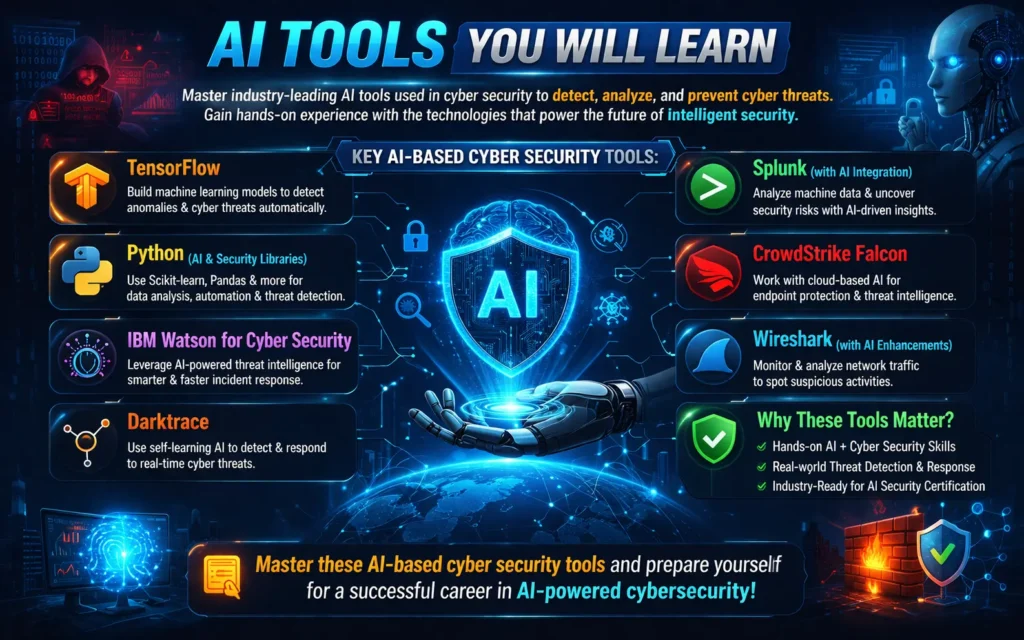
In a professional AI in cyber security training program, you will gain hands-on experience with industry-leading tools that help detect, analyze, and prevent cyber threats using artificial intelligence. These tools are essential for anyone aiming to earn an AI security certification and build a strong career in this field.
Key AI Based Cyber Security Tools:
- TensorFlow
Learn to build machine learning models that can detect anomalies and identify cyber threats automatically. - Python (AI & Security Libraries)
Use Python with libraries like Scikit-learn and Pandas for data analysis, automation, and threat detection. - IBM Watson for Cyber Security
Understand how AI-powered threat intelligence helps in faster decision-making and incident response. - Darktrace
Explore this advanced AI-based cyber security tool that uses self-learning technology to detect real-time cyber threats. - Splunk with AI Integration
Analyze machine-generated data and identify security risks using AI-driven insights. - CrowdStrike Falcon
Work with cloud-based AI tools for endpoint protection and threat intelligence. - Wireshark (with AI enhancements)
Monitor and analyze network traffic to detect suspicious activities.
These AI based cyber security tools help you gain practical skills, improve threat detection accuracy, and prepare you for real-world cyber security challenges.
Conclusion: A Future-Proof Career Path
As we move forward, cybersecurity is becoming more complex, and the traditional methods of securing data are no longer sufficient. AI offers a new way to approach the ever-evolving landscape of cyber threats. By pursuing an Artificial Intelligence Cyber Security Course, you not only prepare for a job in a high-demand field but also help shape the future of digital security. With numerous courses to choose from, ranging from degree programs to certifications, there is a learning path for every aspiring AI cybersecurity expert.
If you’re passionate about using technology to protect the digital world, these courses will provide you with the tools and expertise needed to succeed in one of the most exciting and impactful fields today. So, start exploring your options and step into the future of cybersecurity.
As the world continues to embrace digital transformation, cloud computing has emerged as one of the most important technologies of our time. Cloud platforms, like Amazon Web Services (AWS), have revolutionized the way businesses operate, offering scalable, cost-effective solutions for managing data, applications, and IT infrastructure. As a result, the demand for cloud professionals, especially those skilled in AWS, has skyrocketed.
If you are looking to advance your career or break into the growing field of cloud computing, AWS Training and Certification can be your gateway to success. Whether you’re a seasoned IT professional or someone new to the tech industry, AWS training equips you with the essential skills to thrive in this dynamic sector. In this blog, we’ll explore how AWS training and certification can boost your career and provide you with the tools to succeed in the cloud computing landscape.
Why Choose AWS for Cloud Computing?
Before diving into the specifics of AWS Training and Certification, it’s important to understand why AWS is such a dominant force in the cloud computing market. AWS, part of Amazon’s vast infrastructure, offers a comprehensive suite of cloud services that include compute power, storage, networking, and machine learning, among many others.
Here’s why AWS stands out in the cloud space:
- Market Leader: AWS is the largest cloud services provider, holding a substantial market share. It powers millions of customers worldwide, ranging from startups to large enterprises.
- Wide Range of Services: AWS offers over 175 fully featured services, including computing, storage, databases, artificial intelligence, and IoT, making it a versatile platform for businesses of all sizes.
- Global Infrastructure: AWS has a worldwide network of data centers, which ensures high availability, security, and low latency, no matter where you are located.
- Scalability and Flexibility: AWS allows businesses to scale up or down based on demand, offering both cost efficiency and flexibility.
For individuals looking to specialize in cloud computing, AWS Training and Certification is a valuable way to gain expertise in one of the most widely adopted cloud platforms.
Benefits of AWS Training and Certification
AWS offers various training programs and certification exams that can help you build a career in cloud computing. Here are some key benefits of pursuing AWS Training and Certification:
1. Enhanced Career Opportunities
AWS-certified professionals are in high demand. As more companies migrate their workloads to the cloud, the need for skilled cloud professionals continues to rise. AWS certification validates your skills and knowledge, making you a competitive candidate for roles like cloud architect, DevOps engineer, and cloud developer.
- Top AWS Jobs:
- Cloud Architect
- Cloud Engineer
- AWS Solutions Architect
- DevOps Engineer
- Cloud Security Specialist
- Cloud Consultant
2. Increased Earning Potential
Cloud computing is a rapidly growing field with competitive salaries. According to various industry reports, AWS-certified professionals typically earn more than their non-certified counterparts. The certification demonstrates your expertise in cloud technologies, which can lead to higher-paying roles and career advancement.
3. Up-to-Date Knowledge
AWS regularly updates its training materials to ensure that you stay on top of the latest advancements in cloud technology. By pursuing AWS Training and Certification, you gain access to up-to-date resources and best practices, keeping you ahead of industry trends.
4. Flexibility in Learning
AWS offers a variety of training formats to suit different learning preferences. Whether you prefer instructor-led training, self-paced online courses, or hands-on labs, AWS provides options that work around your schedule. This flexibility allows you to balance learning with work or other commitments.
5. Recognition and Credibility
Earning an AWS certification is a recognized credential that is highly respected in the tech industry. It validates your proficiency in AWS services, demonstrating your expertise to employers, peers, and clients.
Overview of AWS Certification Levels and Tracks
AWS offers a range of certifications designed to meet the needs of professionals at different experience levels. There are three main levels of certification:
1. Foundational Level: AWS Certified Cloud Practitioner
This entry-level certification is ideal for those new to the cloud or AWS. It provides a basic understanding of cloud concepts, AWS services, security, and billing.
- Key Topics Covered:
- AWS Cloud concepts and global infrastructure
- AWS services and pricing models
- Cloud architecture principles
- AWS security features
2. Associate Level: AWS Certified Solutions Architect – Associate
This certification is perfect for professionals who want to design and deploy scalable, highly available systems on AWS. It focuses on the skills required to architect cloud solutions that meet specific requirements.
- Key Topics Covered:
- Designing cost-optimized solutions
- Implementing and deploying AWS systems
- Security and compliance in the cloud
- AWS networking and storage services
Other associate-level certifications include AWS Certified Developer – Associate and AWS Certified SysOps Administrator – Associate.
3. Professional Level: AWS Certified Solutions Architect – Professional
This advanced certification is for professionals with extensive experience in designing and implementing complex cloud solutions. It covers more advanced topics, such as multi-tier architectures, cost optimization, and hybrid cloud environments.
- Key Topics Covered:
- Designing large-scale cloud infrastructures
- Advanced networking and hybrid cloud solutions
- Disaster recovery and fault tolerance
- Complex data storage and processing solutions
The AWS Certified DevOps Engineer – Professional certification is also available for those looking to specialize in DevOps practices using AWS tools.
4. Specialty Level: AWS Certified Security – Specialty
For those interested in security, this certification focuses on AWS security services, best practices, and managing risks in the cloud environment.
- Key Topics Covered:
- AWS security services
- Managing identity and access in AWS
- Protecting data and assets in the cloud
- Incident response and monitoring
AWS also offers other specialty certifications, such as Machine Learning – Specialty, Advanced Networking – Specialty, and Database – Specialty.
How to Get Started with AWS Training and Certification
Here are some steps to help you get started with AWS Training and Certification:
1. Choose the Right Certification Path
Based on your current experience and career goals, decide which certification is right for you. If you’re new to cloud computing, start with the AWS Certified Cloud Practitioner. If you already have experience in IT or cloud computing, consider an associate or professional-level certification.
2. Take AWS Training Courses
AWS offers a variety of training options, including self-paced online courses, live virtual classes, and classroom training. You can choose from foundational to advanced courses depending on your level.
- AWS Training Options:
- Digital Training: On-demand courses available through AWS’s training platform.
- Instructor-Led Training: Live courses with an AWS-certified instructor.
- AWS Labs: Hands-on labs to practice real-world scenarios.
3. Practice with AWS Free Tier
AWS offers a free tier with limited resources that allows you to practice using AWS services without incurring costs. This is a great way to get hands-on experience and familiarize yourself with the platform.
4. Take Practice Exams
Before taking the certification exam, consider using AWS practice exams to test your knowledge and assess your readiness.
5. Schedule Your Exam
Once you’re ready, schedule your exam through the AWS Certification website. You can take the exam online or at a Pearson VUE test center.
AWS Certification Paths 2026
AWS Certification Paths 2026 offer a clear roadmap for individuals who want to build a strong career in cloud computing with Amazon Web Services. These certification paths are designed to match different skill levels, starting from beginners to advanced professionals. Candidates can begin with the Foundational level by earning the AWS Certified Cloud Practitioner certification, which helps them understand core AWS services, pricing, and cloud concepts.
After gaining basic knowledge, learners can move to the Associate level certifications such as Solutions Architect, Developer, and SysOps Administrator. These certifications focus on real-world problem-solving, application deployment, and cloud infrastructure management. For experienced professionals, AWS offers Professional-level certifications like Solutions Architect Professional and DevOps Engineer Professional, which validate advanced technical expertise and complex system design skills.
In 2026, AWS also emphasizes Specialty certifications in areas like Security, Machine Learning, Data Analytics, and Advanced Networking. These certifications help professionals specialize in high-demand domains and increase their career opportunities.
By following structured AWS certification paths, candidates can improve their technical skills, boost their salary potential, and stay competitive in the rapidly evolving IT industry.
SAA-C03 vs SAP-C02
The SAA-C03 and SAP-C02 are popular cloud certifications offered by Amazon Web Services. The AWS Certified Solutions Architect – Associate (SAA-C03) helps learners build skills in designing scalable and cost-efficient cloud solutions. In contrast, the AWS Certified Solutions Architect – Professional (SAP-C02) focuses on advanced architecture design, complex problem-solving, and enterprise-level deployments.
| Feature | SAA-C03 (Associate) | SAP-C02 (Professional) |
|---|---|---|
| Certification Level | Associate level certification | Professional level certification |
| Target Audience | Beginners and intermediate learners | Experienced cloud professionals |
| Focus Area | Basic architecture and core AWS services | Advanced architecture and multi-tier systems |
| Difficulty Level | Moderate and easy to start | Highly advanced and challenging |
| Experience Required | Basic AWS knowledge | Strong hands-on AWS experience |
| Career Impact | Entry to mid-level cloud roles | Senior roles with higher salary potential |
This comparison helps learners choose the right certification based on their experience and career goals.
AWS vs Azure
Both AWS and Microsoft Azure are popular cloud platforms, but they differ in services, ecosystem, and enterprise adoption.
| Feature | AWS | Azure |
| Market Share | Largest cloud provider | Strong enterprise adoption |
| Best For | Startups and enterprises | Microsoft-based organizations |
| Learning Curve | Broad service ecosystem | Easier for Windows admins |
| Popular Services | EC2, S3, Lambda | Virtual Machines, Azure Functions |
| Community Support | Very large | Growing rapidly |
| Global Presence | Extensive | Strong enterprise reach |
Which is Better?
- AWS is ideal for broad cloud expertise.
- Azure is preferred in organizations already using Microsoft technologies.
AWS vs Google Cloud
AWS and Google Cloud Platform are both leading cloud providers, but they serve slightly different needs.
| Feature | AWS | Google Cloud |
| Market Position | Industry leader | Strong in AI and analytics |
| Services | Wide range of cloud tools | Advanced AI and data services |
| Enterprise Usage | Very high | Growing steadily |
| Pricing | Flexible pricing models | Competitive pricing |
| Best Known For | Cloud infrastructure | Machine learning and analytics |
Which One Should You Learn?
- AWS is generally recommended for beginners due to broader job opportunities.
- Google Cloud is valuable for AI, data engineering, and analytics careers.
AWS Solutions Architect vs DevOps Engineer
Many learners get confused between these two career paths.
| Feature | AWS Solutions Architect | AWS DevOps Engineer |
| Main Role | Design cloud infrastructure | Automate deployment and operations |
| Focus Area | Architecture and scalability | CI/CD and automation |
| Skills Needed | Networking, storage, security | Docker, Kubernetes, Jenkins |
| Career Path | Cloud architect roles | DevOps and SRE roles |
| Best For | Infrastructure planners | Automation specialists |
Which Career Path is Better?
- Choose Solutions Architect if you enjoy designing systems.
- Choose DevOps Engineer if you enjoy automation and deployment pipelines.
AWS Training Cost in India
AWS training cost in India depends on the course level, training institute, and learning format. Basic AWS courses usually cost between ₹10,000 and ₹25,000, making them ideal for beginners who want to understand cloud fundamentals. Intermediate and advanced programs, which include hands-on projects and certification preparation from Amazon Web Services, typically range from ₹30,000 to ₹70,000. Online self-paced courses are more affordable, while classroom or mentor-led training costs more due to personalized support. Investing in AWS training helps learners gain in-demand cloud skills, improve career opportunities, and increase earning potential in India’s fast-growing IT industry.
How Long to Prepare for AWS Certification
Preparing for an AWS certification depends on your current experience, learning pace, and the certification level you choose from Amazon Web Services. Beginners typically need 6 to 8 weeks to prepare for the AWS Certified Cloud Practitioner exam, as they must first understand cloud basics, core services, and pricing models. For associate-level certifications like Solutions Architect or Developer, most learners take 2 to 3 months with consistent daily practice and hands-on labs.
Advanced certifications, such as the Professional or Specialty levels, may require 3 to 6 months of preparation, especially for candidates working with complex architectures and real-world scenarios. A structured study plan, regular practice tests, and project-based learning can significantly reduce preparation time. By dedicating focused effort each day, candidates can confidently clear AWS certifications and build strong cloud computing careers.
10 Mistakes People Make in AWS Exams
Many candidates fail AWS exams not because of lack of knowledge, but due to common mistakes they make during preparation and execution. Understanding these mistakes can improve your chances of success in certifications offered by Amazon Web Services.
One major mistake is ignoring the exam blueprint and focusing on random topics. Many learners also rely only on theory without gaining hands-on experience in AWS services. Another common issue is skipping practice tests, which reduces confidence and time management skills. Candidates often underestimate scenario-based questions, which require deep understanding rather than memorization.
Poor time management during the exam leads to unanswered questions, while not reading questions carefully results in selecting incorrect answers. Some learners also ignore key services like IAM, VPC, and S3, which frequently appear in exams. Overconfidence is another mistake, as it prevents proper revision.
Additionally, many candidates follow too many resources, causing confusion instead of clarity. Lack of revision and not analyzing mistakes in mock tests further reduce performance. By avoiding these common errors and following a structured study plan, candidates can increase their chances of clearing AWS exams successfully and building a strong cloud career.
AWS Training Cost in India
AWS training costs vary based on:
- Training institute
- Course duration
- Certification level
- Online or classroom mode
Approximate AWS Course Fees
| Course Level | Estimated Cost |
| Beginner Courses | ₹10,000 – ₹25,000 |
| Associate-Level Training | ₹25,000 – ₹50,000 |
| Professional-Level Training | ₹50,000 – ₹80,000 |
Online self-paced programs are usually more affordable compared to classroom training.
How Long Does AWS Certification Preparation Take?
Preparation time depends on your experience level.
| Certification Level | Preparation Time |
| Cloud Practitioner | 4–8 weeks |
| Associate Level | 2–3 months |
| Professional Level | 3–6 months |
Daily practice and hands-on labs can improve learning speed significantly.
Conclusion: Kickstart Your Career with AWS Training and Certification
In today’s tech-driven world, cloud computing is essential for businesses, and AWS is leading the charge. AWS Training and Certification provides an invaluable opportunity to gain the knowledge and skills needed to succeed in this rapidly growing field. Whether you’re just starting or looking to advance your career, AWS certifications can help you stand out in a competitive job market.
By choosing the right certification path, undergoing comprehensive training, and gaining hands-on experience, you can boost your career and become a trusted cloud expert. So, take the first step today explore AWS training options, earn your certification, and open the door to exciting opportunities in the world of cloud computing.
FAQs About AWS Training and Certification
1. Is AWS certification good for beginners?
Yes, AWS Certified Cloud Practitioner is designed specifically for beginners entering cloud computing.
2. Which AWS certification is best for freshers?
AWS Certified Cloud Practitioner and Solutions Architect Associate are popular choices for freshers.
3. Does AWS certification require coding?
Basic AWS certifications do not require advanced coding knowledge, but scripting skills can help in advanced roles.
4. What is the salary after AWS certification in India?
AWS-certified professionals can earn competitive salaries depending on experience, job role, and certification level.
5. Can non-IT students learn AWS?
Yes, non-IT learners can start with cloud fundamentals and gradually move toward technical certifications.
6. Which is easier: AWS or Azure?
Both platforms have beginner-friendly certifications, but AWS has broader global adoption and job opportunities.
7. Is AWS certification difficult?
Beginner certifications are manageable with proper preparation and hands-on practice.
8. How many times can I attempt AWS certification exams?
AWS allows candidates to retake exams after a waiting period if they do not pass.