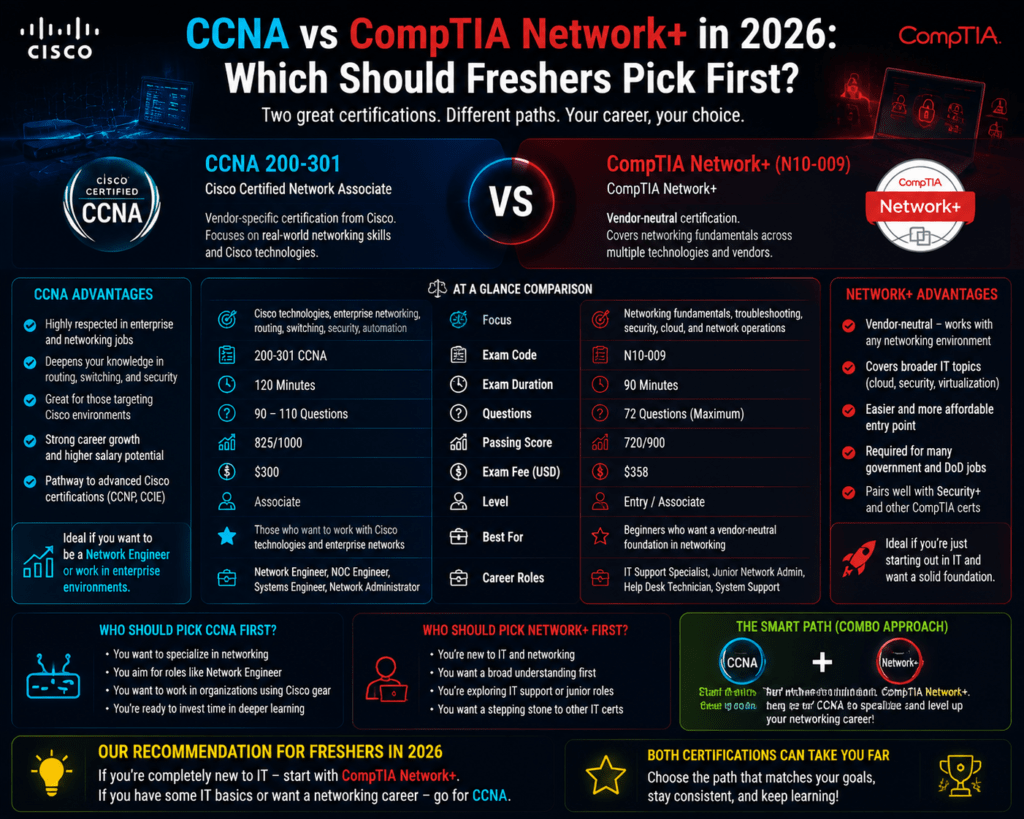
CCNA vs CompTIA Network+ in 2026: Which Should Freshers Pick First?
You have decided to start a networking career.
Now comes one of the first confusing decisions:
CCNA or CompTIA Network+?
Both certifications teach networking fundamentals. Both can help beginners build technical knowledge. And both appear frequently when students research entry-level networking certifications.
But they are not the same.
The simplest answer is this:
Choose CompTIA Network+ if you want a broad networking foundation without focusing heavily on one vendor. Choose CCNA if you already know you want to build deeper practical networking skills and potentially pursue network engineering or Cisco-focused roles.
For many freshers serious about becoming network engineers, CCNA can be the stronger first certification because it goes beyond networking terminology and places significant emphasis on configuring, verifying and troubleshooting networks.
However, Network+ can make more sense for someone who is completely new to IT and wants a broader introduction before going deeper.
Let’s compare CCNA vs CompTIA Network+ in 2026 in detail.
CCNA vs Network+ 2026: Quick Comparison
| Feature | CCNA | CompTIA Network+ |
|---|---|---|
| Current Exam | 200-301 CCNA v1.1 | N10-009 |
| Main Focus | Networking with deeper configuration skills | Broad networking fundamentals |
| Vendor Focus | Cisco-oriented | Broad multi-technology concepts |
| Current Exam Length | 120 minutes | 90 minutes |
| Practical Focus | High | Moderate to High |
| Routing & Switching Depth | Higher | Broader fundamentals |
| Cisco CLI | Important | Not the main focus |
| Cloud Concepts | Included | Included |
| Security | Included | Included |
| Automation | Included | Included |
| Best For | Aspiring network engineers | IT/networking beginners |
| Next Step | CCNP and specialized Cisco paths | Security+, CCNA or other IT certifications |
Cisco’s current CCNA exam covers network fundamentals, network access, IP connectivity, IP services, security fundamentals, and automation and programmability.
CompTIA’s N10-009 objectives cover networking concepts, implementation, operations, security, and troubleshooting, with troubleshooting receiving the largest domain weighting at 24%.
So there is considerable overlap.
The real difference is how deeply and from what perspective each certification approaches networking.
What Is CCNA in 2026?
CCNA stands for Cisco Certified Network Associate.
As of August 2026, the active exam is:
200-301 CCNA v1.1
The examination lasts 120 minutes and costs US$300 before applicable taxes or regional adjustments.
Cisco organizes the current exam around six areas:
- Network Fundamentals
- Network Access
- IP Connectivity
- IP Services
- Security Fundamentals
- Automation and Programmability
CCNA is therefore much broader than simply learning Cisco router commands.
Students learn the fundamentals behind modern networks while also developing knowledge that can be applied to actual network configuration and troubleshooting.
Topics include:
- IPv4 and IPv6
- Subnetting
- VLANs
- Trunking
- Spanning Tree
- EtherChannel
- Static routing
- OSPF
- NAT
- DHCP
- DNS
- ACLs
- Wireless networking
- Network security
- Automation
- APIs
- Programmability
Cisco explicitly positions CCNA as validating networking fundamentals alongside security and software-development-related knowledge.
That combination is one reason CCNA remains attractive for aspiring network engineers.
What Is CompTIA Network+ in 2026?
The current CompTIA Network+ examination is:
N10-009
CompTIA’s official exam objectives state that candidates can face a maximum of 90 multiple-choice and performance-based questions within 90 minutes. CompTIA recommends around 9–12 months of IT networking experience, although the certification is commonly studied as an early networking credential.
Network+ is divided into five areas:
| Network+ N10-009 Domain | Weight |
|---|---|
| Networking Concepts | 23% |
| Network Implementation | 20% |
| Network Operations | 19% |
| Network Security | 14% |
| Network Troubleshooting | 24% |
Its syllabus includes technologies such as:
- OSI model
- Routers and switches
- Firewalls
- IPv4
- IPv6
- Subnetting
- VLANs
- Routing
- OSPF
- BGP concepts
- Wireless networking
- Cloud networking
- VPNs
- Network monitoring
- DNS
- DHCP
- Network security
- Troubleshooting
- SDN
- SD-WAN
- Zero Trust
- SASE
- Infrastructure as Code
CompTIA’s objectives also include modern topics such as SDN, SD-WAN, Zero Trust Architecture, SASE/SSE and Infrastructure as Code.
So Network+ should not be dismissed as an outdated “basic networking” certificate.
Its current syllabus is quite modern.
Biggest Difference: Broad Knowledge vs Deeper Implementation
This is probably the most useful distinction for a fresher.
Network+ teaches you how networking technologies work across a broad environment.
CCNA goes further into how networks are actually configured, verified and troubleshot, especially within Cisco-style enterprise infrastructure.
Consider VLANs.
A Network+ learner should understand:
- Why VLANs exist
- How VLANs segment networks
- VLAN configuration concepts
- 802.1Q tagging
- Native VLANs
- Switch virtual interfaces
CompTIA explicitly includes scenario-based switching configuration topics in N10-009.
A CCNA student also needs those concepts but typically spends considerably more time configuring and troubleshooting them within Cisco network environments.
This difference becomes clearer when you start doing labs.
CCNA students frequently work with router and switch configurations and verify results using network commands.
That experience can be particularly useful for students targeting network support, NOC and network engineering roles.
Which Certification Is Easier for a Complete Beginner?
For someone with almost zero networking knowledge, Network+ may feel easier to approach initially because its structure develops a broad understanding of networking technologies without making Cisco-specific configuration the center of the learning journey.
But “easier” should not be the main decision factor.
A certification should help you reach the job you actually want.
If your target is:
IT Support → System Support → General IT
Network+ can provide an excellent networking foundation.
If your target is:
NOC Engineer → Network Support Engineer → Network Engineer → CCNP
then starting directly with CCNA can save you from studying two heavily overlapping networking certifications.
That does not make Network+ unnecessary.
It simply means the ideal route depends on your career destination.
CCNA Goes Deeper Into Routing and Switching
Routing and switching remain at the heart of most networking careers.
Cisco’s current CCNA syllabus places 25% of the exam on IP Connectivity, while another 20% covers Network Access.
That means a large part of CCNA preparation involves understanding how traffic moves across networks.
Students need to become comfortable with concepts such as:
- Routing tables
- Longest prefix match
- Administrative distance
- Static routing
- Default routing
- IPv4 routes
- IPv6 routes
- OSPF
- VLANs
- Trunks
- Spanning Tree
- EtherChannel
For an aspiring network engineer, this depth matters.
Knowing what OSPF stands for is very different from understanding why two routers fail to establish an OSPF neighbor relationship.
That troubleshooting mindset is where practical training becomes valuable.
Network+ Gives You Broader Infrastructure Exposure
Network+ has its own advantage.
It exposes learners to a broad mix of networking environments rather than concentrating primarily on one vendor ecosystem.
For example, its current objectives include cloud networking, network functions virtualization, VPCs, cloud gateways, SaaS, IaaS, PaaS, SD-WAN, SASE, Zero Trust and Infrastructure as Code.
It also covers operational areas that new IT professionals may encounter, including:
- Documentation
- Asset inventories
- Change management
- Network monitoring
- Disaster recovery
- Backup configurations
- IP address management
- High availability
- Network diagrams
For someone who has not decided whether they want to specialize in networking, systems, cloud or cybersecurity, that breadth can be useful.
Which One Has Better Troubleshooting Coverage?
Both.
But they approach it differently.
Troubleshooting is actually the largest Network+ N10-009 domain at 24%. CompTIA expects candidates to follow a structured troubleshooting methodology and diagnose networking problems.
CCNA integrates troubleshooting throughout topics such as interfaces, switching, routing, IP services and network connectivity.
Cisco also provides lab-oriented learning environments such as Cisco Modeling Labs for designing, building and troubleshooting network environments.
For freshers, the important lesson is this:
Do not prepare for either certification using theory alone.
Open a lab.
Build the network.
Break something.
Then fix it.
That process teaches networking much faster than memorizing hundreds of definitions.
What About Security?
Both certifications now include meaningful security coverage.
Network+ N10-009 dedicates 14% of the exam to Network Security. Its objectives cover concepts including:
- Encryption
- PKI
- IAM
- MFA
- RADIUS
- TACACS+
- Least privilege
- Network segmentation
- ACLs
- 802.1X
- NAC
- Common network attacks
CCNA currently dedicates 15% of its blueprint to Security Fundamentals.
That makes both useful foundations for someone who may later move into cybersecurity.
But if your long-term plan involves Cisco network security, CCNP Security, enterprise networking or advanced network engineering, CCNA provides a more direct Cisco certification path.
What About Automation and Modern Networking?
This is another area where the gap has narrowed.
Network+ now includes concepts such as:
- Infrastructure as Code
- Automation
- Templates
- Configuration drift
- Version control
- SDN
- SD-WAN
CCNA has a dedicated Automation and Programmability section worth 10% of the current exam.
Cisco’s current CCNA also includes modern topics such as automation, programmability and AI-related networking concepts, which makes it more aligned with the direction Cisco is taking its professional certifications.
So whichever certification you choose, the networking career of 2026 is no longer only about cables, routers and CLI commands.
Modern network professionals increasingly need to understand automation and software-driven infrastructure too.
CCNA Is Changing Again in 2027
Freshers starting their studies late in 2026 should know about an important transition.
The current CCNA 200-301 v1.1 remains available through February 2, 2027.
Cisco launches CCNA v2.0 on February 3, 2027.
Cisco says the new version will place more emphasis on practical problem-solving, troubleshooting, security and AI-assisted network operations.
If you can prepare properly and take v1.1 before the transition, there is no reason to delay purely because a new blueprint is coming. Cisco itself recommends that current candidates continue rather than waiting unnecessarily.
If your exam will be after February 3, 2027, prepare using the v2.0 blueprint.
Which Certification Is Better for Getting a Networking Job?
A certification alone does not guarantee employment.
This is important for every fresher to understand.
Employers can evaluate:
- Networking fundamentals
- Troubleshooting ability
- Practical labs
- Communication skills
- Internship experience
- Projects
- Certification knowledge
For a dedicated network engineering path, CCNA has a particularly natural advantage because its syllabus develops deeper skills around enterprise routing, switching and Cisco networking.
For broad entry-level IT roles, Network+ can demonstrate that you understand networking without tying your knowledge to one networking vendor.
So instead of asking:
“Which certificate looks better on my resume?”
ask:
“Which certification teaches the skills required for the role I want?”
That question usually leads to a better decision.
Should Freshers Do Network+ and Then CCNA?
You can.
But you do not always need to.
There is significant topic overlap between the two exams.
Both teach:
- OSI concepts
- TCP/IP
- IP addressing
- Subnetting
- Routing
- Switching
- VLANs
- Wireless
- Security
- Network services
- Troubleshooting
- Automation concepts
So taking both certifications makes the most sense when you have a specific reason.
A complete beginner could follow:
Network+ → CCNA → CCNP
This provides a gentle progression from broad networking concepts toward deeper enterprise networking.
But a fresher who is already committed to becoming a network engineer could choose:
CCNA → Labs/Projects → Entry-Level Networking Role → CCNP
That route is often more direct.
Who Should Pick CompTIA Network+ First?
Start with Network+ if:
- You are completely new to IT.
- You want a broad networking foundation.
- You have not chosen a networking vendor.
- You may move into IT support, cloud or cybersecurity later.
- You want to understand networking before specializing.
- Cisco configuration is not currently your priority.
Network+ is particularly useful when networking is one part of the IT knowledge you want rather than your entire career specialization.
Who Should Pick CCNA First?
Start with CCNA if:
- You specifically want a networking career.
- You want to become a Network Engineer.
- You are targeting NOC or network-support roles.
- You want deeper routing and switching knowledge.
- You enjoy hands-on configuration.
- You want to progress toward CCNP.
- You plan to work with Cisco technologies.
- You want practical enterprise networking exposure.
For these learners, going directly into CCNA can be the more efficient route.
Best Path for an Indian Fresher in 2026
If you are a B.Tech, BCA, BSc, diploma or other graduate planning a networking career, a practical roadmap can look like this:
Step 1: Learn the fundamentals
Understand:
- OSI
- TCP/IP
- IPv4
- IPv6
- Subnetting
- Ethernet
- Basic routing
- Basic switching
Step 2: Prepare for CCNA
Move into:
- VLANs
- Trunks
- STP
- EtherChannel
- Static routing
- OSPF
- NAT
- DHCP
- ACLs
- Wireless
- Security
- Automation
Step 3: Spend Serious Time in Labs
Build topologies.
Configure routers and switches.
Create connectivity problems deliberately.
Then troubleshoot them.
Step 4: Build Interview Skills
Be prepared to answer practical questions such as:
Why can’t two VLANs communicate?
How does a switch learn MAC addresses?
What happens when you type a website address into a browser?
How does a router choose the best route?
A fresher who can explain these clearly often demonstrates more useful knowledge than someone who only memorized certification questions.
Step 5: Move Toward CCNP After Building the Foundation
Once CCNA concepts become comfortable, professional-level networking becomes easier to approach.
Learning CCNA With Networkers Champ
For students who decide that CCNA is the right first step, Networkers Champ currently offers CCNA Enterprise training with an emphasis on hands-on labs, routing and switching, real-world scenarios and practical networking skills.
Its broader Cisco training pages also emphasize practical work with routers, switches, firewalls and network devices rather than theory alone.
Suggested Internal Anchor: CCNA Training in Bangalore
Suggested Secondary Internal Links:
- CCNA Enterprise Training
- CCNP Training in Bangalore
- Cisco Networking Courses
- CCNA, CCNP & CCIE Training
This article is especially suitable for linking to the CCNA course after the reader reaches the decision section rather than pushing the course in the introduction.
Final Verdict: CCNA or Network+ for Freshers?
So, CCNA vs CompTIA Network+ — which should a fresher pick first in 2026?
There is no universal winner.
Choose Network+ first if you want a broad, technology-neutral introduction to networking before specializing.
Choose CCNA first if you already know you want to build a career in networking and want deeper routing, switching, configuration and troubleshooting skills.
For a fresher whose clear goal is to become a Network Engineer, NOC Engineer or Network Support Engineer, our preferred path would usually be:
CCNA first.
Why?
Because instead of learning networking only from a conceptual level, you can start connecting theory to actual configuration and troubleshooting.
If you are still exploring IT and deciding between networking, cybersecurity, cloud, system administration and technical support, Network+ can be a useful first foundation.
The certification name, however, should not become your entire strategy.
Whichever path you choose, combine it with:
Theory + Labs + Troubleshooting + Projects + Interview Practice
That combination matters far more than collecting certifications without being able to configure or troubleshoot a real network.
FAQs About CCNA vs CompTIA Network+ in 2026
Is CCNA better than Network+ for freshers?
For freshers specifically targeting network engineering, CCNA can be the more direct option because it develops deeper routing, switching, configuration and troubleshooting knowledge. Network+ can be better for beginners wanting broader networking knowledge before choosing a specialization. Cisco’s current CCNA explicitly validates configuration and troubleshooting-related networking skills.
Is Network+ easier than CCNA?
Network+ generally has a broader conceptual scope, while CCNA goes deeper into Cisco-oriented configuration and enterprise networking. Difficulty ultimately depends on the learner’s existing networking knowledge and practical experience.
Can I do CCNA without Network+?
Yes. Network+ is not a prerequisite for CCNA. Cisco requires candidates to pass the 200-301 CCNA exam to earn the certification and does not list Network+ as a prerequisite.
Can a complete fresher start CCNA?
Yes. A fresher can begin learning CCNA from networking fundamentals. However, practical lab work is important because the syllabus moves beyond introductory terminology into IP connectivity, network access, services, security and automation.
What is the current Network+ exam in 2026?
The current exam is CompTIA Network+ N10-009. Its official objectives specify up to 90 multiple-choice and performance-based questions in 90 minutes.
What is the current CCNA exam in 2026?
As of August 2026, candidates take 200-301 CCNA v1.1. It is a 120-minute exam priced at US$300 before applicable taxes or regional pricing differences.
Does Network+ teach Cisco commands?
Network+ focuses on networking concepts and scenario-based implementation rather than being a Cisco IOS certification. Its official objectives cover broad technologies including routers, switches, VLANs, OSPF, BGP, wireless, cloud networking, SD-WAN and Infrastructure as Code.
Which certification should I take if I want to become a network engineer?
If network engineering is already your clear career goal, CCNA is usually the more direct starting point because Cisco’s curriculum goes deeply into network access, IP connectivity, services, security and automation.
Should I take Network+ before CCNA?
You can, especially if you need a gentle introduction to networking. But it is not mandatory. Because the certifications overlap significantly, students already committed to a networking career can often begin directly with CCNA.
Is CCNA changing in 2027?
Yes. The current CCNA v1.1 is available through February 2, 2027. CCNA v2.0 launches February 3, 2027, so students planning a later exam should study against the appropriate blueprint.