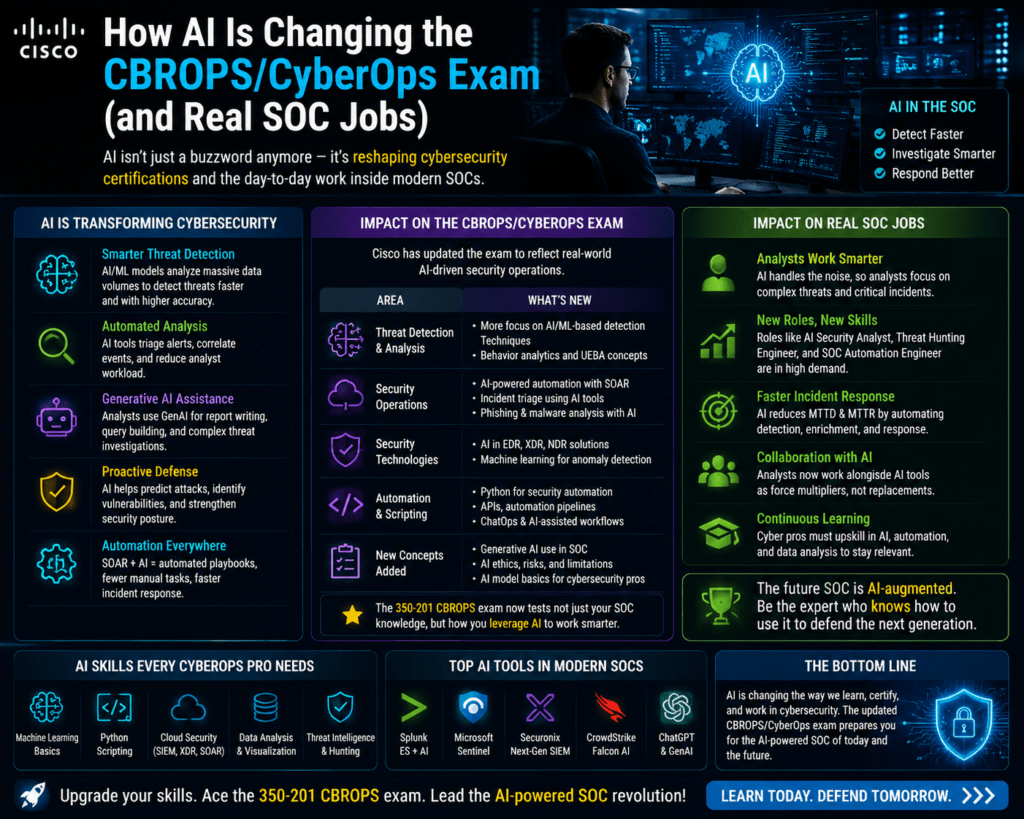
How AI Is Changing the CBROPS/CyberOps Exam — and Real SOC Jobs
Artificial intelligence is changing cybersecurity faster than many entry-level certification guides suggest.
If you are preparing for Cisco CyberOps, you may already notice terms such as predictive AI, behavioral detection, generative AI, SIEM, SOAR, anomaly detection, and automated incident response appearing alongside traditional security topics.
There is an important certification update to understand first.
The certification many learners still call CyberOps Associate or CBROPS is now officially CCNA Cybersecurity. Cisco’s current associate exam is 200-201 CCNACBR v1.2 – Understanding Cisco Cybersecurity Operations Fundamentals. It is a 120-minute exam covering security concepts, security monitoring, host-based analysis, network intrusion analysis, and security policies and procedures.
So, while “CBROPS” and “CyberOps” remain useful search terms, students preparing in 2026 should follow the current CCNACBR v1.2 blueprint.
And one of the most interesting changes in that blueprint is AI.
Cisco has explicitly added predictive AI to associate-level cybersecurity skills and says its cybersecurity certifications have been updated to reflect AI’s role in incident response and threat defense.
But does this mean SOC analysts are being replaced?
No.
It means the SOC analyst job is changing.
From CBROPS to CCNA Cybersecurity: What Changed?
Older Cisco learners may remember:
200-201 CBROPS – Understanding Cisco Cybersecurity Operations Fundamentals
The exam was associated with the CyberOps Associate certification.
Cisco later rebranded its CyberOps certifications under its broader Cybersecurity certification family. In the current certification structure, passing 200-201 CCNACBR v1.2 earns the CCNA Cybersecurity certification.
The fundamental objective has not disappeared.
Cisco still wants candidates to understand how analysts:
- Monitor security events
- Investigate suspicious activity
- Analyze endpoints
- Examine network traffic
- Interpret logs
- Identify attacks
- Respond to incidents
- Follow security procedures
What has changed is the environment in which these tasks happen.
Modern analysts increasingly work beside machine-learning systems, AI assistants, automated playbooks, XDR platforms, SIEM tools, and SOAR systems.
Cisco’s certification content is beginning to reflect that reality.
Current CCNA Cybersecurity 200-201 Exam Domains
The current CCNACBR v1.2 blueprint is divided into five main domains:
| Domain | Weight |
|---|---|
| Security Concepts | 20% |
| Security Monitoring | 25% |
| Host-Based Analysis | 20% |
| Network Intrusion Analysis | 20% |
| Security Policies and Procedures | 15% |
These percentages come directly from Cisco’s current 200-201 v1.2 blueprint.
AI does not replace these domains.
Instead, Cisco is weaving AI into the way candidates understand detection, endpoint security, social engineering, and modern security monitoring.
Where Does AI Appear in the CyberOps Exam?
There are two especially important areas.
1. Predictive AI in Endpoint Security
Under Host-Based Analysis, Cisco expects candidates to understand how endpoint technologies perform security monitoring using:
- Rules
- Signatures
- Predictive AI
The blueprint applies this to technologies including:
- Host-based intrusion detection
- Antimalware and antivirus
- Host-based firewalls
This is an important shift.
Traditional security tools often depend heavily on known signatures.
For example, if security software already knows the signature of a malicious file, it can detect that file when it appears again.
But attackers continuously change malware.
Predictive systems can look beyond a single known signature and use patterns, behaviors, and other signals to identify suspicious activity.
For a CCNA Cybersecurity candidate, the goal is not to become a machine-learning engineer.
You need to understand how AI-assisted detection changes the analyst’s workflow.
2. Generative AI Is Now Part of the Threat Landscape
AI is not only helping defenders.
Attackers can use it too.
Cisco’s current Security Monitoring blueprint explicitly includes social engineering attacks using both manual methods and generative AI.
This matters because phishing and social engineering are changing.
A traditional phishing email might contain poor grammar, strange wording, or obvious formatting problems.
Generative AI can make fraudulent communication more polished and more personalized.
That means SOC analysts cannot rely on “this email looks badly written” as an effective defense strategy.
They need to investigate stronger signals.
For example:
- Sender identity
- URLs
- Domains
- Authentication results
- Endpoint activity
- User behavior
- Network connections
- File hashes
- Process execution
- Threat intelligence
This is exactly why fundamental analysis skills remain important even as AI becomes more capable.
What Does Predictive AI Actually Mean for a SOC Analyst?
Imagine that a company generates thousands of endpoint events every hour.
A human analyst cannot manually inspect every process, network connection, login attempt, and file event.
AI and machine learning can analyze large amounts of telemetry and identify activity that differs from established patterns.
A platform might notice:
A user normally logs in from Bangalore between 9 AM and 6 PM.
Then an account suddenly authenticates from another region at 3 AM and accesses unusual systems.
That does not automatically prove an attack.
It creates a signal worth investigating.
This distinction is critical.
AI can identify patterns. The analyst still needs to interpret context.
Cisco itself emphasizes that engineers and operators need the ability to validate AI recommendations, identify false positives, interpret trends, and remain the human decision-maker.
AI Is Changing Real SOC Work Too
The exam update makes more sense when you look at what is happening inside real Security Operations Centers.
A traditional Tier 1 SOC workflow often looks something like this:
Alert → Read logs → Collect context → Check reputation → Compare events → Decide severity → Escalate or close
Much of that work is repetitive.
Modern AI-assisted security platforms can help perform parts of that workflow faster.
AI can increasingly assist with:
- Alert summarization
- Event correlation
- Log interpretation
- Alert prioritization
- Threat intelligence enrichment
- False-positive reduction
- Incident timelines
- Investigation recommendations
- Query creation
- Detection support
- Automated response workflows
For example, Cisco reported in 2026 that Deloitte Japan was validating a security-focused AI model for SOC workflows involving alert analysis, prioritization, and false-positive reduction.
That is not a theoretical use case.
It demonstrates the type of repetitive SOC work AI is increasingly being used to accelerate.
What an AI-Assisted SOC Investigation Looks Like
Consider a suspicious endpoint alert.
Traditional Workflow
An analyst might manually:
- Read the detection.
- Search the IP address.
- Inspect the hostname.
- Check the user’s activity.
- Search SIEM logs.
- Check endpoint telemetry.
- Look for related events.
- Identify the MITRE ATT&CK technique.
- Write an incident summary.
- Decide whether to escalate.
That can take time.
AI-Assisted Workflow
The platform may immediately provide:
- A summarized incident
- Related alerts
- Associated devices
- Suspicious users
- Attack techniques
- Relevant telemetry
- Risk level
- Possible root cause
- Recommended next actions
The analyst can then focus more energy on the most important question:
Is the AI’s conclusion correct?
That final question is becoming one of the most valuable SOC skills.
Cisco Live 2026 Shows What This Looks Like in Practice
Cisco offered a particularly useful example through its working SOC at Cisco Live Americas 2026.
Analysts were given AI-generated incident summaries that connected relevant logs and provided information such as confidence and possible attack tactics or techniques. The analysts were still encouraged to investigate further rather than blindly accepting the AI-generated conclusion.
Cisco’s broader review of that SOC reached an important conclusion: AI was helping analysts operate faster and at greater scale, but human judgment remained essential.
This is likely a good model for understanding the future SOC.
Not:
AI versus analysts.
But:
AI + analysts.
Will AI Replace Tier 1 SOC Analysts?
This is one of the biggest concerns among cybersecurity beginners.
Some Tier 1 tasks are clearly becoming easier to automate.
For example:
- Basic enrichment
- Repetitive alert checks
- Simple log summaries
- Known malicious indicator lookup
- Duplicate alert handling
- Routine notifications
- Basic incident classification
At Cisco Live Americas 2026, Cisco even documented situations where automated workflows could handle particular compromised-device or account notifications without requiring manual analyst intervention.
However, this does not mean entry-level cybersecurity careers disappear.
It changes what employers will expect from entry-level analysts.
Cisco’s own 2026 view of modern security operations is that analysts who use AI effectively can outperform those who do not, while the SOC itself becomes a combination of humans, automation, and intelligent systems.
The lower-value task is becoming:
Copy data from Tool A into Tool B.
The higher-value skill is becoming:
Understand whether the evidence actually indicates an attack.
The New SOC Analyst Skill Set
A future-ready SOC analyst should develop six areas especially well.
1. Security Fundamentals
AI cannot compensate for weak fundamentals.
You still need to understand:
- CIA triad
- Threats
- Vulnerabilities
- Exploits
- Malware
- Authentication
- Access control
- Defense in depth
- Security architecture
These remain explicit parts of the current CCNA Cybersecurity syllabus.
2. Network Analysis
You should understand:
- TCP/IP
- DNS
- HTTP/HTTPS
- TCP and UDP ports
- IPv4 and IPv6
- ICMP
- ARP
- Network flows
The current exam asks candidates to interpret protocol information and identify key elements of network intrusions from packet data.
An AI assistant may tell you that traffic looks suspicious.
A good analyst understands why.
3. Log Analysis
Modern SOCs depend heavily on telemetry.
Students should become comfortable interpreting:
- Windows logs
- Linux logs
- Firewall logs
- Endpoint events
- SIEM events
- Application logs
Cisco specifically tests candidates on interpreting operating-system, SIEM, SOAR, application, and command-line logs to identify events.
4. SIEM, SOAR and XDR
These platforms are becoming central to AI-assisted security operations.
SIEM helps collect and correlate security data.
SOAR helps automate workflows.
XDR connects security signals across multiple environments.
Cisco’s current exam already expects candidates to understand SIEM and SOAR concepts, while Cisco’s XDR platform uses analytics and threat intelligence to correlate security data and help analysts prioritize threats.
5. AI Output Validation
This may become one of the most important new skills.
Do not automatically trust:
“High-confidence ransomware detected.”
Ask:
- Which events support that conclusion?
- What endpoint generated them?
- Is the process legitimate?
- Is this a true positive?
- What evidence is missing?
- Could normal behavior explain the alert?
Cisco’s own guidance for AI-era operations emphasizes validating recommendations and identifying false positives rather than blindly accepting machine output.
6. Incident Response
Someone still needs to decide what happens next.
Should the account be disabled?
Should the endpoint be isolated?
Is escalation required?
Could containment interrupt an important business system?
Cisco’s current CCNA Cybersecurity blueprint continues to test incident response planning, incident handling, detection and analysis, containment, eradication, recovery, and post-incident activity.
That human judgment becomes more valuable as response becomes faster.
What Should You Study Differently for the CyberOps Exam in 2026?
Do not throw away traditional CyberOps study material.
Instead, add an AI-aware layer to it.
When studying endpoint security, ask:
How are signatures different from predictive detection?
When studying phishing, ask:
How could generative AI make this attack more convincing?
When studying SIEM alerts, ask:
Could AI correlate these events automatically?
When studying incident response, ask:
Which steps can be automated and which require human approval?
When studying false positives, ask:
How would I verify whether an AI-generated conclusion is trustworthy?
This approach prepares you for both the certification and the workplace.
Practical Labs Matter More Than Ever
Reading definitions is not enough for a SOC career.
Practice with:
- Wireshark
- PCAP analysis
- Linux logs
- Windows event logs
- SIEM searches
- Malware analysis reports
- Threat intelligence
- Incident-response scenarios
- Firewall events
- Endpoint alerts
The current CCNACBR blueprint includes practical interpretation tasks such as identifying events from logs, examining malware analysis output, extracting information from packet captures, and interpreting intrusion artifacts.
That is why hands-on cybersecurity training can make a significant difference.
Preparing With Networkers Champ
Networkers Champ currently offers CCNA Cyber Ops training in Bangalore and Indore aimed at aspiring cybersecurity professionals and associate-level SOC analyst roles.
The program focuses on skills such as:
- Security monitoring
- Threat detection
- Cyberattack analysis
- Incident response
- SOC operations
For SEO and conversion, a natural internal link from this article would be:
Anchor Text: CCNA CyberOps Training in Bangalore
Another useful internal connection could be your:
CCNA Training
and
CCNP Security Training
pages for readers who want to expand their networking and cybersecurity foundation.
One future website improvement would also be worth considering: because Cisco now officially uses CCNA Cybersecurity, Networkers Champ can retain “CyberOps” for search demand while gradually incorporating the new certification name across headings and course copy.
Is CCNA Cybersecurity Still Worth It in the AI Era?
Yes, particularly for beginners who want to understand defensive cybersecurity and SOC operations.
AI makes security fundamentals more important, not less important.
If an AI assistant tells you:
“This traffic may indicate command-and-control activity.”
Someone must understand:
- What command and control means
- Which protocol is involved
- Which endpoint initiated the session
- Whether the domain is suspicious
- Which logs support the conclusion
- Whether containment is justified
Without those fundamentals, you are simply trusting software.
The value of the future SOC analyst is not the ability to manually perform every repetitive task.
It is the ability to investigate, verify, reason and respond correctly.
Final Thoughts: AI Is Changing CyberOps, Not Killing It
AI is already changing both the CyberOps/CCNA Cybersecurity exam and real SOC jobs.
Cisco’s current associate blueprint now includes predictive AI in endpoint monitoring and generative AI within the social-engineering threat landscape. Cisco also says predictive AI is becoming part of associate-level cybersecurity preparation.
At the same time, real SOC environments are using AI to summarize incidents, correlate data, prioritize alerts, reduce repetitive work, and support faster investigation.
But there is one skill AI does not remove:
Cybersecurity judgment.
The SOC analyst of the future may spend less time manually collecting information.
They may spend more time asking whether the information is accurate.
They will need to understand networks, endpoints, logs, attacks, SIEM data, incident response, automation, and AI-assisted detection.
For students preparing today, that is the real lesson behind Cisco’s updated CyberOps pathway.
Don’t learn only how to use security tools. Learn how to think like the analyst who must verify what those tools tell you.
FAQs: AI, CBROPS and CCNA Cybersecurity
Is CBROPS still the current Cisco exam?
The certification has been renamed. Cisco’s current associate cybersecurity exam is 200-201 CCNACBR v1.2, and passing it earns CCNA Cybersecurity. Many learners still use “CBROPS” and “CyberOps” when searching for the certification.
Does the CCNA Cybersecurity exam include AI?
Yes. The current blueprint includes predictive AI in endpoint security monitoring and also covers generative-AI-enabled social engineering attacks.
Do I need to learn machine learning programming for CCNACBR?
The associate blueprint focuses on understanding how predictive AI is used in cybersecurity monitoring rather than requiring candidates to develop machine-learning models. The broader exam remains focused on security monitoring, host analysis, intrusion analysis and incident-response fundamentals.
Will AI replace SOC analysts?
AI can automate parts of triage, enrichment, summarization and routine response. However, Cisco’s own 2026 SOC experience emphasizes the continued need for analysts to validate AI conclusions, investigate further and apply human judgment.
What AI skills should an entry-level SOC analyst learn?
Start with understanding predictive detection, anomaly detection, AI-generated security summaries, false-positive validation and how AI fits into SIEM, SOAR and XDR workflows. Strong networking, log analysis and incident-response skills remain essential.
What jobs can CCNA Cybersecurity help prepare for?
Cisco positions its training around foundational skills for junior or entry-level cybersecurity operations analysts working in Security Operations Centers.
Is CyberOps good for a fresher in 2026?
It can be a strong starting point for someone interested in defensive cybersecurity because the curriculum combines networking-related security, monitoring, endpoint analysis, packet analysis and incident-response concepts with newer AI-assisted security techniques.