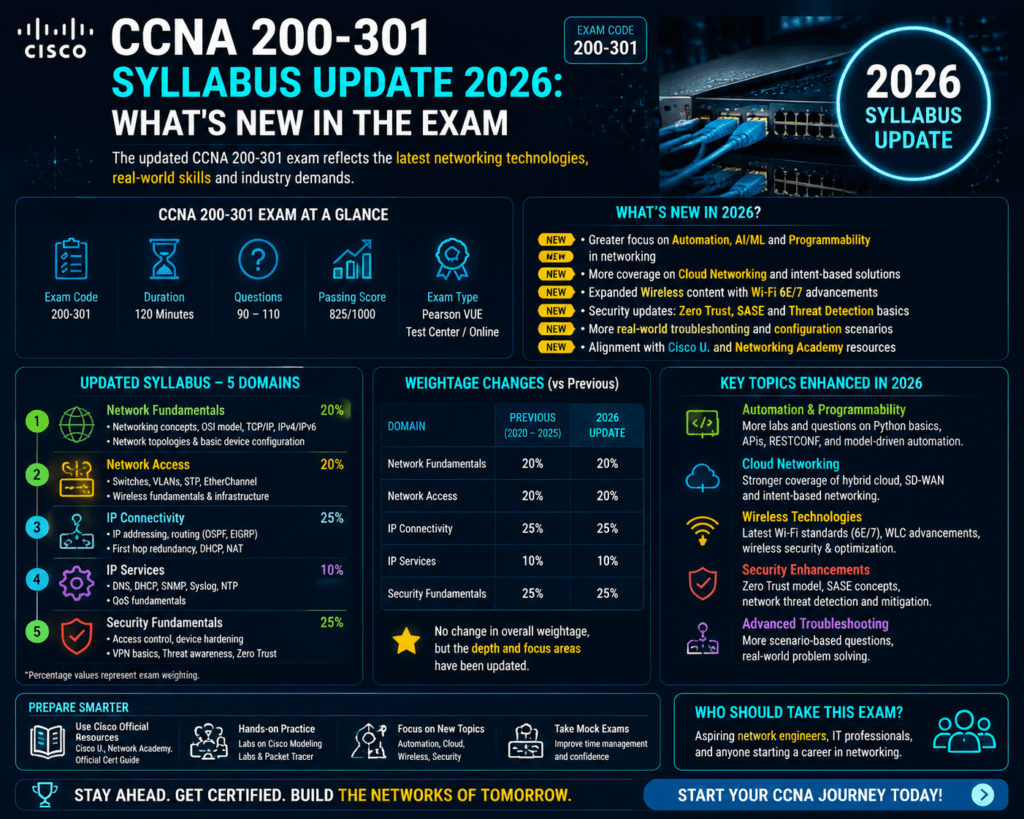
CCNA 200-301 Syllabus Update 2026: What’s New in the Exam?
The CCNA 200-301 syllabus update 2026 is creating plenty of confusion among Cisco certification students.
You may have seen posts claiming that Cisco has already launched a completely new CCNA exam in 2026.
That is not exactly what happened.
As of August 2026, candidates are still taking 200-301 CCNA v1.1. Cisco officially announced and published the blueprint for the much larger CCNA v2.0 update on May 20, 2026, but the new exam does not become active until February 3, 2027.
So, if your CCNA exam is scheduled during 2026, you should continue preparing for the current v1.1 blueprint.
However, if you are just beginning your networking journey and expect to take your exam in 2027, understanding the new syllabus now is extremely important.
Cisco is making the first major CCNA blueprint redesign since 2019. The new direction places more emphasis on troubleshooting, security, practical networking skills, automation, and artificial intelligence.
Let’s break down what you need to study now and what is changing next.
Is There a New CCNA Exam in 2026?
Technically, no new CCNA exam became active in 2026.
Cisco currently lists the active certification exam as:
200-301 CCNA v1.1 – Implementing and Administering Cisco Solutions
It is a 120-minute exam covering networking fundamentals, network access, IP connectivity, IP services, security fundamentals, automation, and programmability.
What happened in May 2026 was different.
Cisco released the blueprint for CCNA v2.0, giving students more than eight months to understand and prepare for the changes before the new version goes live on February 3, 2027.
Cisco has specifically told candidates already preparing for the current CCNA that there is no reason to change course. The current exam remains available until the refreshed exam takes effect.
That distinction is important.
Taking CCNA before February 3, 2027?
Prepare for CCNA v1.1.
Taking CCNA from February 3, 2027?
Prepare for CCNA v2.0.
Current CCNA 200-301 v1.1 Syllabus in 2026
The current CCNA exam is divided into six main domains.
| CCNA v1.1 Domain | Exam Weight |
|---|---|
| Network Fundamentals | 20% |
| Network Access | 20% |
| IP Connectivity | 25% |
| IP Services | 10% |
| Security Fundamentals | 15% |
| Automation and Programmability | 10% |
Cisco’s official current blueprint confirms these domain weightings.
Understanding the weight of each section can help you decide where to spend more study time.
IP Connectivity remains particularly important because it represents 25% of the exam.
However, passing CCNA requires a broad understanding of the entire network rather than mastering only one area.
1. Network Fundamentals – 20%
Network Fundamentals provides the foundation for almost everything else in CCNA.
Students should understand areas such as:
- Routers and Layer 2/Layer 3 switches
- Firewalls
- Access points
- Network topologies
- TCP and UDP
- IPv4 addressing
- IPv6 addressing
- Subnetting
- Wireless principles
- Cabling
- Interface problems
- Virtualization concepts
This section helps you understand how network devices communicate and how traffic moves through an infrastructure.
Do not underestimate subnetting.
Even when a question is not directly labelled as subnetting, address calculations can affect routing, VLANs, access control lists, and troubleshooting.
2. Network Access – 20%
The Network Access section focuses heavily on switching and how devices connect to networks.
Important areas include:
- VLANs
- Access ports
- Voice VLANs
- Trunking
- EtherChannel
- CDP
- LLDP
- Rapid PVST+
- Wireless architectures
- WLAN components
- Management access
Cisco’s v1.1 update also added more Spanning Tree protection concepts, including root guard, loop guard, BPDU filter, and BPDU guard.
Candidates should understand not only what these technologies are but also why they are used.
For example, simply knowing what a VLAN means is not enough.
You should understand how to configure VLANs, assign switch ports, configure trunks, and verify whether VLAN traffic is working correctly.
3. IP Connectivity – 25%
IP Connectivity carries the highest percentage in the current CCNA blueprint.
This section covers how routers decide where packets should go.
Important topics include:
- Routing tables
- Routing decisions
- Static routes
- Default routes
- IPv4 routing
- IPv6 routing
- OSPF
- Administrative distance
- Metrics
- First Hop Redundancy Protocol concepts
You should be comfortable looking at a routing table and answering questions such as:
Which route will the router choose?
What is the next hop?
Why is one route preferred over another?
Why is a destination unreachable?
This is where hands-on lab practice becomes extremely valuable.
Reading routing theory is very different from troubleshooting a router that is not forwarding packets correctly.
4. IP Services – 10%
The IP Services section connects routing and switching to services used by real enterprise networks.
Topics commonly include:
- NAT
- NTP
- DHCP
- DNS
- SNMP
- Syslog
- QoS
- SSH
- TFTP
- FTP
These services may represent only 10% of the blueprint, but they appear constantly in real networking environments.
Understanding DHCP, NAT, DNS, NTP, and SSH is particularly useful when troubleshooting practical network problems.
5. Security Fundamentals – 15%
Security is now a core networking skill rather than something only cybersecurity engineers need.
The current CCNA syllabus includes topics such as:
- Common security threats
- Vulnerabilities
- Security concepts
- Password policies
- Local authentication
- AAA concepts
- Access Control Lists
- Layer 2 security
- DHCP snooping
- Dynamic ARP Inspection
- Port security
- Wireless security
- VPN concepts
Security fundamentals currently represent 15% of the CCNA v1.1 exam.
This area becomes even more significant when we look at Cisco’s future CCNA direction.
Cisco says the upcoming blueprint is built around developing a stronger security-first mindset rather than treating security as an isolated topic.
6. Automation and Programmability – 10%
This is one of the areas that makes the modern CCNA different from older versions.
Networking is no longer completely CLI-driven.
The current CCNA includes:
- Network automation
- Controller-based networking
- Software-defined architectures
- APIs
- JSON
- Configuration management
- Ansible
- Terraform
- Artificial intelligence
- Machine learning concepts
Automation and Programmability accounts for 10% of the current v1.1 exam.
The v1.1 update added introductory coverage of generative AI, predictive AI, and machine learning in network operations.
Cisco also added Terraform and Ansible concepts and moved away from older DNA Center-specific device-management coverage.
The important word here is introductory.
For the current v1.1 exam, Cisco expects high-level knowledge of AI and machine learning rather than expert-level AI configuration.
What Is Changing in the New CCNA v2.0 Syllabus?
This is where the 2026 announcement becomes much more interesting.
Cisco says CCNA v2.0 is the first major CCNA blueprint change since 2019.
Instead of the existing six-domain structure, the new blueprint is organized around five larger areas:
| Upcoming CCNA v2.0 Domain | Weight |
|---|---|
| Network Infrastructure and Connectivity | 25% |
| Switching and Network Access | 25% |
| IP Routing | 20% |
| Network Services and Security | 20% |
| AI and Network Operations and Management | 10% |
Cisco’s published v2.0 blueprint confirms this revised structure.
This is more than moving percentages around.
The language Cisco uses throughout the updated blueprint shows a stronger focus on diagnosing, configuring, verifying, troubleshooting, and operating networks.
Biggest Change #1: Troubleshooting Becomes Much More Important
The next CCNA is moving away from a learning model based heavily on memorizing networking definitions.
Cisco says the new blueprint is built around troubleshooting and problem-solving as one of its central pillars.
For example, the new Network Infrastructure and Connectivity section specifically includes diagnosing interface and cabling problems.
This represents the kind of problem a junior network engineer actually faces.
Instead of asking only:
What is duplex?
Cisco may expect you to understand symptoms caused by mismatched duplex settings.
Instead of only knowing what a route is, you need to understand why traffic is taking a particular path.
This means practical lab preparation becomes even more important.
Biggest Change #2: AI Gets Its Own CCNA Domain
Perhaps the most attention-grabbing update is the new section:
AI and Network Operations and Management – 10%
Cisco is no longer placing AI inside a few scattered automation objectives.
The new blueprint gives AI and modern network operations their own 10% domain.
The official topics include areas such as:
- The role of agentic AI in network operations
- Generative AI
- Selecting prompts for AI systems
- Network operations
- Network management
This does not mean CCNA is becoming an artificial intelligence engineering certification.
You are not suddenly expected to train machine-learning models.
Instead, Cisco wants future network engineers to understand how AI tools are becoming part of network operations.
Biggest Change #3: Stronger Security-First Networking
The current blueprint has Security Fundamentals as a separate 15% section.
The upcoming CCNA merges network services and security into a combined 20% domain, while Cisco also says security-first thinking is one of the main pillars across the new certification.
That reflects a realistic networking environment.
Security cannot simply be added after a network is built.
Network engineers need to think about secure device access, segmentation, authentication, Layer 2 protections, policies, and secure management from the beginning.
Biggest Change #4: More Hands-On Skills
Cisco has also announced a shift in how candidates will learn and demonstrate their knowledge.
Future training will include more experiential learning and hands-on lab activity.
Cisco says the refreshed exam will also test more practical skills, with the goal of validating whether candidates are actually job-ready.
This is probably one of the most important changes for students.
Simply watching hours of videos and memorizing commands may become less effective.
You should practice:
- Configuring switches
- Building VLANs
- Configuring trunks
- Setting up routing
- Troubleshooting OSPF
- Creating ACLs
- Diagnosing connectivity
- Checking interfaces
- Understanding routing tables
- Configuring network services
The more comfortable you are inside a real or simulated network, the better prepared you will be.
CCNA v1.1 vs CCNA v2.0: Quick Comparison
| Feature | CCNA v1.1 | CCNA v2.0 |
|---|---|---|
| Active in August 2026 | Yes | No |
| Launch date | Already active | February 3, 2027 |
| Main domains | 6 | 5 |
| Networking fundamentals | Strong focus | Strong focus |
| Troubleshooting | Included | Greater emphasis |
| Security | Separate domain | More integrated |
| AI | Introductory topics | Dedicated 10% domain |
| Automation | Included | Integrated with modern operations |
| Practical skills | Important | Greater emphasis |
| Agentic AI | Not major focus | Explicitly included |
The v2.0 launch timing and its emphasis on infrastructure, troubleshooting, security and AI come directly from Cisco’s 2026 certification announcement and published blueprint.
Should You Wait for CCNA v2.0?
For most students already preparing in 2026, no.
Cisco itself says candidates studying for the current CCNA should continue their preparation rather than changing course.
If you can become ready before February 3, 2027, taking v1.1 is completely valid.
Your CCNA certification does not suddenly become useless when a new exam blueprint appears.
The certification demonstrates that you passed the active CCNA requirements at the time of your exam.
However, if your planned exam date is after February 3, 2027, start incorporating v2.0 topics into your preparation now.
How Should You Prepare for CCNA in 2026?
A strong preparation approach should combine theory and practical work.
Start with networking fundamentals
Master IPv4, IPv6, subnetting, Ethernet, TCP/IP, switching and routing.
Do not rush toward advanced automation before you understand basic packet forwarding.
Practice configurations
Use labs to configure:
- VLANs
- Trunks
- EtherChannel
- STP
- OSPF
- Static routing
- NAT
- DHCP
- ACLs
- Device security
Learn troubleshooting
Deliberately create problems in your labs.
Remove a route.
Use the wrong subnet mask.
Break a trunk.
Create an incorrect VLAN assignment.
Then diagnose the issue.
This develops skills that will become even more important under the future blueprint.
Understand automation and AI concepts
For current v1.1 candidates, understand AI, machine learning, Ansible, Terraform, APIs, and automation at the level required by Cisco.
Candidates preparing for v2.0 should go further into AI-assisted network operations and the new blueprint objectives.
Prepare for CCNA With Networkers Champ
A structured training environment can be especially useful because the modern CCNA requires more than reading a certification book.
Networkers Champ provides CCNA Enterprise 200-301 training in Bangalore, with instructors focused on practical, real-world networking scenarios.
Networkers Champ also emphasizes hands-on Cisco training and practical lab experience across its networking programs.
For students preparing during this transition period, training should ideally cover both:
The current CCNA v1.1 exam requirements
and
the skills Cisco is moving toward with CCNA v2.0.
Suggested Internal Link: CCNA Training in Bangalore
Suggested Anchor: CCNA Enterprise 200-301 Training
Final Thoughts
The CCNA 200-301 syllabus update 2026 is important, but candidates need to understand the timeline correctly.
As of August 2026, CCNA 200-301 v1.1 remains the active exam.
Cisco published the next major CCNA blueprint on May 20, 2026, and CCNA v2.0 officially takes effect on February 3, 2027.
The new direction is clear.
Cisco wants future CCNA professionals to do more than memorize networking concepts.
They need to understand infrastructure.
Configure it.
Secure it.
Troubleshoot it.
Operate it.
And increasingly, understand how AI can assist with network management.
If you are taking CCNA during 2026, continue studying v1.1 and build as much hands-on experience as possible.
If you are preparing for 2027, start learning the new v2.0 topics now.
Either way, strong fundamentals remain the foundation.
AI may change how networks are operated.
But you still need to understand why the network works before you can intelligently automate or troubleshoot it.
FAQs About the CCNA 200-301 Syllabus Update 2026
Is the CCNA syllabus changing in 2026?
Cisco published a new CCNA v2.0 blueprint on May 20, 2026, but it does not become the active exam until February 3, 2027. The current exam during 2026 remains CCNA 200-301 v1.1.
What is the current CCNA exam in 2026?
The current exam is 200-301 CCNA v1.1 – Implementing and Administering Cisco Solutions. It is a 120-minute exam.
When does CCNA v2.0 start?
Cisco has scheduled the refreshed CCNA v2.0 exam to go live on February 3, 2027.
Does the CCNA exam include AI?
Yes. Current CCNA v1.1 already includes introductory generative AI, predictive AI, and machine-learning concepts. CCNA v2.0 expands this significantly by creating a dedicated AI and Network Operations domain worth 10%.
Is Python required for CCNA 200-301?
CCNA includes automation and programmability concepts, but it is not a Python programming certification. Candidates should understand networking automation concepts, APIs, structured data and how modern automation technologies fit into network management.
Should I take CCNA in 2026 or wait until 2027?
If you are already preparing and can take the exam before February 3, 2027, Cisco advises candidates to continue studying for the current version rather than changing direction.
What are the current CCNA exam percentages?
The current v1.1 domains are Network Fundamentals 20%, Network Access 20%, IP Connectivity 25%, IP Services 10%, Security Fundamentals 15%, and Automation and Programmability 10%.
What is the biggest change in CCNA v2.0?
The biggest overall shift is toward practical troubleshooting, security-first networking and AI-assisted operations. AI and Network Operations becomes its own 10% domain, while Cisco is also increasing the emphasis on hands-on skills.