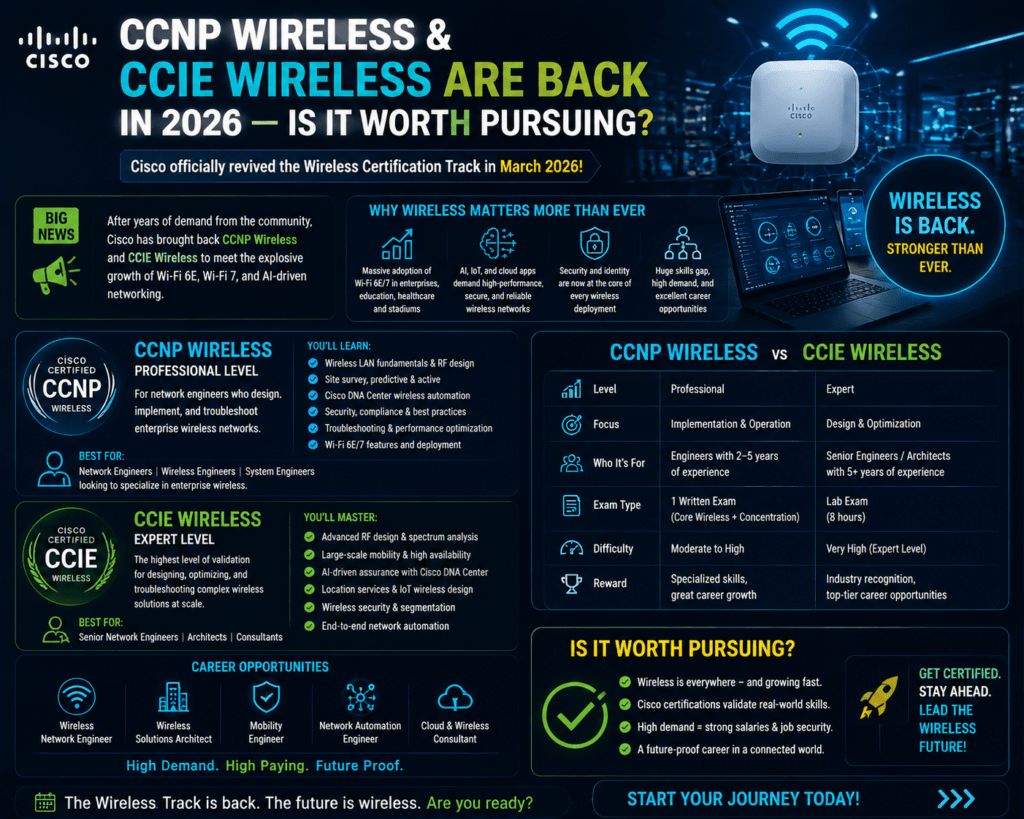
CCNP Wireless & CCIE Wireless Are Back in 2026 — Is It Worth Pursuing?
Cisco wireless certifications are back in the spotlight.
On March 19, 2026, Cisco officially launched its dedicated CCNP Wireless and CCIE Wireless certification track, giving wireless engineers a standalone professional-to-expert certification path once again.
This is much more than Cisco bringing back an old certification name.
The new CCNP Wireless 2026 path covers modern enterprise wireless technologies such as RF fundamentals, Wi-Fi standards, client connectivity, wireless monitoring, network design, automation, artificial intelligence, security, and advanced wireless implementation. CCIE Wireless goes even further, adding expert-level design, deployment, optimization, Wi-Fi 6, Wi-Fi 7, Meraki, analytics, and automation.
For wireless engineers, network professionals, CCNP Enterprise holders, and people planning a specialized Cisco career, the big question is:
Is CCNP Wireless or CCIE Wireless actually worth pursuing in 2026?
For the right career path, the answer is yes.
But it is not the right certification for everyone.
Let’s break down exactly what Cisco changed and who should consider this revived wireless track.
What Changed With Cisco Wireless Certifications in 2026?
During Cisco’s previous certification structure, wireless specialization largely lived within the Enterprise certification ecosystem.
Cisco has now re-established wireless as its own dedicated certification track.
The new structure provides a much clearer progression:
Wireless Foundations → CCNP Wireless → CCIE Wireless
Cisco announced the new track in August 2025 and made the new certifications available for testing on March 19, 2026.
This means someone who wants to build a career specifically around enterprise Wi-Fi no longer needs to treat wireless simply as a concentration inside a broader Enterprise certification.
Wireless now has its own professional core exam.
That exam is:
350-101 WLCOR v1.0 – Implementing and Operating Cisco Wireless Core Technologies
The WLCOR exam is used for both CCNP Wireless and CCIE Wireless.
That makes Cisco’s new wireless ladder similar to its other specialist tracks: build strong core knowledge first, then progress toward either professional specialization or expert-level practical skills.
Why Did Cisco Bring Back a Dedicated Wireless Track?
Enterprise wireless networking has changed dramatically.
Wi-Fi is no longer simply about installing access points and configuring an SSID.
Modern wireless engineers may need to work with:
- RF design and optimization
- Wi-Fi 6
- Wi-Fi 7
- High-density wireless environments
- Wireless security
- Location services
- Mobility
- QoS
- Multicast
- Cloud-managed networking
- Cisco Meraki
- Catalyst Center
- Automation
- APIs
- AI-assisted network operations
- Wireless analytics
Cisco’s official CCNP Wireless objectives now specifically include automation and AI alongside traditional RF, 802.11, connectivity, management, and troubleshooting skills.
This is important.
Wireless engineering has become specialized enough to justify a dedicated learning and certification path.
A network engineer may understand routing and switching extremely well but still lack the RF, roaming, interference, antenna, mobility, and wireless troubleshooting knowledge required to design a large enterprise WLAN correctly.
Cisco’s 2026 changes acknowledge that difference.
What Is CCNP Wireless 2026?
CCNP Wireless is Cisco’s professional-level certification for people who design, implement, operate, monitor, and troubleshoot modern enterprise wireless networks.
There are no formal prerequisites.
Cisco notes, however, that professional-level candidates commonly have around three to five years of experience implementing enterprise network solutions.
To earn CCNP Wireless, you need to pass:
One core exam + one concentration exam
The core exam is:
350-101 WLCOR
Implementing and Operating Cisco Wireless Core Technologies
WLCOR is currently a 120-minute exam costing US$400. Passing it also earns the Cisco Certified Specialist – Wireless Core credential.
The exam validates knowledge of key areas including:
- Radio frequency fundamentals
- 802.11 technologies
- Client connectivity
- Wireless monitoring
- Wireless management
- Automation
- Artificial intelligence
Cisco also expects candidates to understand Python components and scripts, wireless infrastructure APIs, and AI capabilities within platforms such as Catalyst Center.
That gives the new certification a noticeably modern direction.
CCNP Wireless Concentration Exams
After WLCOR, you choose one concentration.
Cisco currently provides two options.
300-110 WLSD – Designing Cisco Wireless Networks
Choose WLSD if your career is moving toward wireless design.
The exam focuses on areas such as:
- Wireless site surveys
- Wireless infrastructure design
- Wired infrastructure considerations
- Mobility
- WLAN high availability
The exam currently lasts 90 minutes and costs US$300.
This path is especially relevant for professionals who want to work on wireless architecture, planning, design, consulting, or large enterprise deployments.
300-120 WLSI – Implementing Cisco Wireless Advanced Solutions
The second option focuses more heavily on advanced implementation.
Topics include:
- FlexConnect
- Quality of Service
- Multicast
- Advanced location services
- Client connectivity security
- Wireless monitoring
- Device hardening
WLSI is also currently a 90-minute, US$300 concentration exam.
This path may suit engineers who spend more time configuring, operating, troubleshooting, and optimizing enterprise WLAN environments.
What Happened to the Old Enterprise Wireless Concentrations?
Experienced Cisco learners may recognize some of these topics.
That is because wireless design and implementation previously existed as concentration choices within CCNP Enterprise.
Cisco moved those wireless specializations into the dedicated CCNP Wireless track when the new structure launched on March 19, 2026.
At the same time, Cisco said wireless concepts covered by the new WLCOR certification would no longer be part of the Enterprise core in the same way.
This creates a clearer separation.
CCNP Enterprise can concentrate more heavily on broad enterprise infrastructure.
CCNP Wireless can go deeper into Wi-Fi and WLAN engineering.
For candidates who need both skill sets, the certifications can complement each other rather than compete.
What Is CCIE Wireless 2026?
CCIE Wireless is the expert-level destination.
Cisco describes it as validating mastery of planning, designing, implementing, operating, and optimizing complex enterprise wireless networks.
To earn CCIE Wireless, candidates need:
350-101 WLCOR + CCIE Wireless Lab Exam v1.1
There are no formal prerequisites.
Cisco recommends that candidates typically have around five to seven years of experience designing, deploying, operating, and optimizing enterprise wireless technologies before attempting the expert certification.
That recommendation is important.
CCIE Wireless is not designed as a certification for someone who has just finished CCNA.
It is an expert-level destination.
CCIE Wireless Lab Exam Explained
After passing WLCOR, candidates must pass the CCIE Wireless Lab Exam v1.1.
This is an eight-hour hands-on practical exam.
Cisco says candidates are challenged to plan, design, deploy, operate, and optimize complex wireless networks across the full technology lifecycle.
The current lab exam costs US$1,600.
Cisco’s refreshed CCIE Wireless track also expands coverage of modern wireless technologies, particularly:
- Wi-Fi 6
- Wi-Fi 7
- Cisco Meraki
- Enterprise wireless design
- Wireless operations
- Automation
- Analytics
- Security
Cisco specifically highlighted Wi-Fi 6, Wi-Fi 7, and Meraki when announcing the refreshed expert track.
This makes the 2026 CCIE Wireless considerably more relevant to modern WLAN environments than simply reviving an old exam blueprint.
Wi-Fi 7 Makes This Certification More Interesting
One of the strongest reasons Cisco’s decision makes sense is Wi-Fi 7.
Enterprise wireless infrastructure continues to evolve.
Wireless professionals now need to understand how newer standards affect capacity, spectrum usage, client behavior, network design, performance, and deployment strategy.
Cisco specifically designed its revived Wireless certification track to include modern standards such as Wi-Fi 6 and Wi-Fi 7.
For engineers who built most of their skills around earlier Wi-Fi generations, this gives certification study a practical purpose.
You are not only preparing for an exam.
You are updating your knowledge for newer enterprise WLAN environments.
AI and Automation Are Now Part of Wireless Engineering
Another major change is automation.
Traditional wireless engineers spent a lot of time working directly with wireless LAN controllers and individual infrastructure components.
Modern networks increasingly use centralized controllers, APIs, automation platforms, telemetry, analytics, and intelligent operations.
Cisco’s CCNP Wireless curriculum now explicitly covers:
- Python components
- Python scripts
- Wireless infrastructure APIs
- Automation
- Catalyst Center
- AI Analytics
- AI Operations
This means CCNP Wireless is not simply an RF certification.
Cisco is preparing wireless engineers for an environment where infrastructure management is increasingly software-driven.
For professionals who already understand Python, APIs, DevNet concepts, or network automation, that creates an interesting opportunity to combine those skills with deep wireless expertise.
Meraki Is Important Too
Cisco Meraki also plays a bigger role in the refreshed wireless direction.
Cisco specifically included its cloud-managed Meraki technology in the new CCIE Wireless track.
That reflects what modern engineers increasingly encounter in real environments: traditional controller-based infrastructure and cloud-managed networking can both matter.
Networkers Champ already provides Cisco Meraki training covering cloud-managed networking technologies, making Meraki knowledge a useful complementary skill for students targeting advanced wireless roles.
Suggested internal anchor: Cisco Meraki Training
CCNP Enterprise vs CCNP Wireless: Which One Should You Choose?
This is probably the most important decision for many Cisco learners.
Choose CCNP Enterprise if you want broader enterprise networking
CCNP Enterprise makes more sense if your work focuses on:
- Routing
- Switching
- Enterprise infrastructure
- SD-WAN
- Network assurance
- General enterprise networking
- Automation
It gives you a broader enterprise networking profile.
Choose CCNP Wireless if you want to specialize deeply in Wi-Fi
CCNP Wireless makes more sense if your work focuses on:
- Enterprise WLAN
- RF
- Wireless controllers
- Access points
- Wireless security
- Wi-Fi design
- Site surveys
- Roaming
- Mobility
- Wireless troubleshooting
- High-density Wi-Fi
- Wi-Fi 6/7
Cisco itself positions potential CCNP Wireless roles around wireless network engineering and wireless network architecture.
For some professionals, earning both can be powerful.
One shows broad enterprise networking competence.
The other demonstrates deep wireless specialization.
Is CCNP Wireless Worth It in 2026?
Yes — if wireless networking is a meaningful part of your current or target job.
CCNP Wireless is especially worth considering if you want to become a:
- Wireless Network Engineer
- WLAN Engineer
- Wireless Consultant
- Network Implementation Engineer
- Wireless Network Designer
- Mobility Engineer
- Wireless Solutions Engineer
- Wireless Network Architect
Cisco itself identifies wireless network engineer and wireless network architect among the potential roles associated with the professional certification.
However, CCNP Wireless may not be your first priority if your role is almost completely focused on routing, switching, service provider networks, cybersecurity, or data centers.
Specialization works best when it matches your career direction.
Is CCIE Wireless Worth It in 2026?
CCIE Wireless requires a much bigger commitment.
It makes the most sense for experienced professionals targeting roles such as:
- Senior Wireless Engineer
- Wireless Architect
- Wireless Consultant
- Enterprise Wireless Solutions Consultant
- Technical Lead
- Wireless Infrastructure Specialist
Cisco specifically positions CCIE Wireless toward senior wireless engineering, architecture, and enterprise wireless consulting work.
The certification should therefore be viewed as an expert-level career investment, not simply another badge to collect.
If your daily work involves complex enterprise wireless infrastructure and you want to become one of the specialists responsible for designing and optimizing that infrastructure, CCIE Wireless can be a logical long-term goal.
Who Should Not Jump Directly Into CCIE Wireless?
Someone with weak networking fundamentals should not start by preparing for an expert-level wireless lab.
A stronger path is:
Networking fundamentals → CCNA-level knowledge → Wireless fundamentals → CCNP Wireless → Real-world experience → CCIE Wireless
Cisco has no formal prerequisite, but its recommendation of five to seven years of relevant experience for CCIE Wireless tells you the expected depth.
You need more than exam knowledge.
You need to understand what happens when clients cannot authenticate.
Why roaming fails.
How RF interference affects performance.
How wireless and wired infrastructure interact.
How to design high availability.
How to troubleshoot complex WLAN behavior.
And how to optimize a network rather than simply make it work.
How to Prepare for CCNP Wireless in 2026
A strong preparation strategy should include several stages.
1. Strengthen networking fundamentals
Make sure you understand:
- IPv4 and IPv6
- VLANs
- Switching
- Routing
- DHCP
- DNS
- Authentication
- QoS
- Network troubleshooting
2. Master RF fundamentals
Learn channels, frequency bands, interference, signal strength, SNR, antennas, power levels, and channel planning.
3. Understand 802.11 deeply
Do not treat Wi-Fi as simply Ethernet without cables.
Learn how clients discover, authenticate, associate, roam, and communicate.
4. Build wireless labs
Practical experience matters.
Cisco’s own preparation resources emphasize hands-on labs using Cisco technologies.
5. Learn automation
Build basic Python and API knowledge.
Automation and AI are directly part of the new WLCOR scope.
6. Learn modern platforms
Develop familiarity with Catalyst wireless technologies, Catalyst Center, and Meraki alongside RF fundamentals.
Preparing With Networkers Champ
For students looking for instructor-led Cisco training, Networkers Champ already provides a path covering networking fundamentals, professional Cisco training, Meraki, and expert-level wireless education.
Its current CCIE training portfolio lists CCIE Enterprise Wireless training aimed at wireless infrastructure specialists, with classroom and online learning options.
The Networkers Champ course catalog also emphasizes real Cisco hardware, practical lab work, and CCIE-certified trainers across its Cisco programs.
For this blog, useful internal links would be:
- CCIE Wireless Training
- CCNP Training in Bangalore
- CCNA Training
- Cisco Meraki Training
- Cisco Networking Courses
These links create a natural learning journey rather than pushing a course CTA too early.
Final Verdict: Should You Pursue CCNP or CCIE Wireless?
Cisco bringing back a dedicated CCNP Wireless and CCIE Wireless certification track in 2026 is significant.
It reflects how specialized modern enterprise Wi-Fi has become.
The new track is not simply about access points and controllers.
It combines RF engineering with Wi-Fi 6, Wi-Fi 7, security, mobility, analytics, automation, APIs, AI-assisted operations, Catalyst technologies, and Meraki.
If you are a general network engineer, CCNP Enterprise may still provide the broader starting point.
If you want to become the person organizations rely on to design, deploy, troubleshoot, and optimize enterprise wireless infrastructure, CCNP Wireless is now one of Cisco’s clearest specialist paths.
And if you already have years of serious wireless experience and want to prove expert-level capability, CCIE Wireless gives that specialization its own identity again.
For wireless professionals, Cisco’s message in 2026 is clear:
Wireless is no longer just a small part of Enterprise certification. It is a specialist career path of its own.
FAQs About CCNP Wireless and CCIE Wireless 2026
1. Is CCNP Wireless back in 2026?
Yes. Cisco officially made the dedicated CCNP Wireless certification available on March 19, 2026.
2. What is the CCNP Wireless core exam?
The core exam is 350-101 WLCOR v1.0 – Implementing and Operating Cisco Wireless Core Technologies.
3. Which exams are required for CCNP Wireless?
You must pass 350-101 WLCOR plus either 300-110 WLSD or 300-120 WLSI.
4. Does CCNP Wireless include AI?
Yes. Cisco lists automation and AI as part of WLCOR, including Python, wireless infrastructure APIs, AI Analytics, and AI Operations concepts.
5. Does the new Wireless certification cover Wi-Fi 7?
Cisco specifically includes Wi-Fi 6 and Wi-Fi 7 in its refreshed expert Wireless track.
6. How do I earn CCIE Wireless?
You need to pass the 350-101 WLCOR core exam and the CCIE Wireless Lab Exam v1.1.
7. How long is the CCIE Wireless lab?
The CCIE Wireless practical lab is currently eight hours and costs US$1,600.
8. Is CCNP Wireless worth it after CCNA?
It can be, especially if you already have strong networking fundamentals and want to specialize in enterprise WLAN, RF, wireless design, Wi-Fi security, troubleshooting, or mobility. For students without solid networking fundamentals, building CCNA-level knowledge first is usually the more practical path.
9. CCNP Enterprise or CCNP Wireless: which is better?
Neither is universally better. CCNP Enterprise is broader, while CCNP Wireless is much more specialized. Choose Enterprise for general enterprise infrastructure and Wireless when WLAN engineering is your primary career focus.
10. Is CCIE Wireless suitable for beginners?
No formal prerequisite exists, but Cisco recommends roughly five to seven years of relevant enterprise wireless experience before attempting the expert certification.