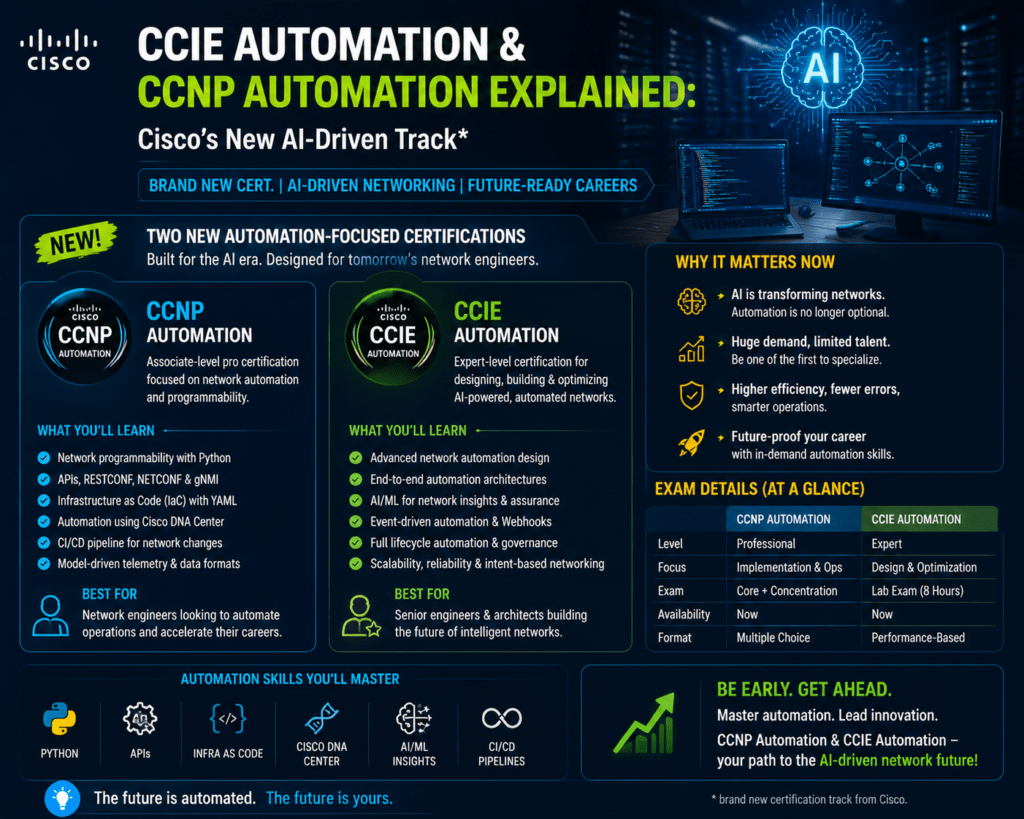
CCIE Automation & CCNP Automation Explained: Cisco’s New AI-Driven Track
CCIE Automation and CCNP Automation are two of the most important additions to Cisco’s certification portfolio in 2026.
They also reveal something bigger about the future of networking.
Cisco no longer expects advanced network engineers to work only with routers, switches, CLI commands, and traditional troubleshooting. Modern engineers increasingly need automation, APIs, Python, Infrastructure as Code, CI/CD, observability, and even AI-assisted operations.
That change is now reflected directly in Cisco certifications.
On February 3, 2026, Cisco transitioned its DevNet certification family into a new Automation pathway using its familiar certification structure:
CCNA Automation → CCNP Automation → CCIE Automation
The pathway builds on Cisco’s previous DevNet program rather than starting completely from zero. However, Cisco has also redesigned parts of the professional and expert-level content to reflect how network automation roles are changing.
For network engineers planning their next certification, this could become one of Cisco’s most relevant career tracks.
Let’s understand exactly what changed.
What Is Cisco’s New Automation Certification Track?
Cisco’s Automation certification pathway focuses on combining networking knowledge with software, automation, programmability, and modern infrastructure operations.
The three levels are:
| Level | Certification |
|---|---|
| Associate | CCNA Automation |
| Professional | CCNP Automation |
| Expert | CCIE Automation |
The naming changed officially on February 3, 2026. Active DevNet certifications affected by the transition moved into the corresponding Automation certification names.
This makes Cisco’s automation journey much easier to understand.
Instead of having networking certifications on one side and a separately branded DevNet family on another, professionals can now see a clear progression.
Start with automation fundamentals.
Move into professional network automation.
Then develop expert-level NetDevOps and automation architecture skills.
Is CCNP Automation Just DevNet Professional Renamed?
Not exactly.
This is an important distinction.
Cisco describes CCNP Automation as a renamed certification that has also been reimagined. The certification still builds on the foundation created through DevNet, but its professional-level focus has shifted more heavily toward real network automation engineering.
That means Cisco is placing more attention on professionals who understand networks and can automate them at scale.
The central exam for this certification is:
350-901 AUTOCOR v2.0
Designing, Deploying, and Managing Network Automation Systems
AUTOCOR is a 120-minute core examination. Cisco currently prices it at US$400. Passing AUTOCOR also earns the Cisco Certified Automation Specialist – Core certification.
More importantly, the AUTOCOR v2.0 blueprint specifically includes:
- Network automation system development
- Automation architecture and design
- Infrastructure as Code
- Network operations
- Software-driven infrastructure
- AI in automation
Cisco explicitly lists AI in automation within the current AUTOCOR examination scope.
That makes CCNP Automation particularly interesting in 2026.
How Do You Earn CCNP Automation?
Cisco follows the same professional-level structure used by several other CCNP tracks.
To earn CCNP Automation, you must pass:
One core exam + one concentration exam
The core exam is:
350-901 AUTOCOR
After that, you choose a specialization.
Cisco currently lists concentration options that include areas such as Enterprise Automation and Data Center Automation.
For example:
300-435 ENAUTO
Automating and Programming Cisco Enterprise Solutions
This exam focuses on implementing automated enterprise solutions, including device-level automation, controller-based automation, network operations, and AI in automation.
Another option is:
300-635 DCNAUTO
Automating Cisco Data Center Networking Solutions
This concentration covers Data Center automation, Infrastructure as Code, network element programmability, operations, and AI in automation.
This means candidates can develop a strong automation foundation and then specialize based on the environments they work with.
What Skills Does CCNP Automation Cover?
The certification reflects a noticeable shift from manual network administration toward programmable infrastructure.
A CCNP Automation learner should expect to develop knowledge across areas such as:
Python
Python continues to be one of the most useful programming languages for network engineers.
Instead of manually repeating the same configuration across dozens or hundreds of devices, engineers can build scripts and workflows to automate repetitive tasks.
REST APIs
Modern Cisco platforms expose APIs that allow engineers to retrieve information, modify configurations, integrate platforms, and build automated workflows.
Understanding how APIs work is therefore essential for modern network automation.
Infrastructure as Code
Infrastructure as Code allows teams to define infrastructure through structured files and code rather than performing every configuration manually.
Cisco’s current Automation pathway places clear emphasis on Infrastructure as Code.
Ansible
Ansible is widely used for configuration automation and orchestration.
At expert level, Cisco specifically expects candidates to understand areas such as developing and managing Ansible roles.
Terraform
Cisco also includes infrastructure orchestration with Terraform within its expert Automation skill set.
Git and CI/CD
Network changes increasingly follow software-development-style workflows.
Cisco’s expert Automation objectives include Git usage and CI/CD pipeline troubleshooting, bringing networking closer to modern DevOps and NetDevOps practices.
That is a major change from the networking career many engineers entered ten years ago.
What Is CCIE Automation?
CCIE Automation is Cisco’s expert-level certification for professionals who can design and develop advanced network automation solutions.
Cisco describes the certification as validating automation capabilities across the entire network lifecycle — from concept and deployment through operation and optimization.
This is not simply a certification about writing a few Python scripts.
Cisco expects expert-level candidates to work across software development, networking, automation architecture, Infrastructure as Code, deployment pipelines, APIs, security, troubleshooting, and operations.
Cisco lists potential career directions including:
- Network Engineer
- Network Automation Engineer
- DevOps Engineer
The certification effectively sits at the intersection of networking and software-driven infrastructure.
How Do You Earn CCIE Automation?
The CCIE Automation path requires two exams.
Step 1: Pass 350-901 AUTOCOR
Interestingly, CCNP Automation and CCIE Automation share the same core exam.
The 350-901 AUTOCOR v2.0 exam satisfies the core requirement for both certifications.
This creates a logical progression.
Someone can prepare for AUTOCOR, earn the Automation Core Specialist credential, complete a concentration exam to achieve CCNP Automation, and later continue toward the expert practical exam.
Step 2: Pass the CCIE Automation Practical Exam
As of August 2026, Cisco lists the current CCIE Automation practical exam v1.1.
It is an 8-hour hands-on examination.
Cisco says the exam tests whether candidates can plan, design, develop, test, deploy, and maintain software solutions in complex automation-driven network environments.
Cisco currently lists the practical exam price as US$1,600.
This immediately tells you something important.
CCIE Automation is not designed around memorizing terminology.
You need to build things.
You need to troubleshoot.
You need to automate.
And you need to understand what happens when those automated systems fail.
Where Does AI Fit Into CCNP and CCIE Automation?
This is where the new track becomes especially relevant.
Calling the current certification an AI-only certification would be inaccurate.
It is primarily a network automation certification.
However, AI is increasingly becoming part of that automation environment.
Cisco’s AUTOCOR v2.0 explicitly tests AI in automation. Enterprise and Data Center automation concentration exams also mention AI within their automation and operations objectives.
Cisco is taking the idea even further at the CCIE level.
In 2026, Cisco announced broader plans to integrate AI tools into CCIE practical examinations so engineers can demonstrate their ability to use AI for configuration, troubleshooting, diagnostics, output validation, coding assistance, and AIOps-related tasks.
The direction is clear:
AI is becoming another tool that expert network engineers must know how to use responsibly.
It does not eliminate networking knowledge.
It makes strong networking knowledge even more important because engineers need to validate what AI produces.
A Bigger CCIE Automation Update Is Coming in 2027
This is one of the most important details for students planning long-term preparation.
Cisco has already announced CCIE Automation v1.2, scheduled to launch on March 23, 2027.
Cisco says the v1.2 update will strengthen areas including:
- AI-driven operations
- Modern DevOps
- Cloud-native workflows
- Automated infrastructure
- Human-led decision-making in AI-first environments
Cisco describes the philosophy as keeping the engineer “human-in-the-lead” while using automation and AI to improve efficiency.
For someone beginning CCIE Automation preparation in 2026, this upcoming blueprint is worth watching carefully.
Candidates planning an exam attempt after March 23, 2027 should prepare using the v1.2 blueprint rather than assuming today’s v1.1 practical exam will remain unchanged.
Why Network Engineers Should Pay Attention
For years, networking careers followed a fairly predictable route:
Learn networking fundamentals.
Learn routing and switching.
Become good at CLI configuration.
Master advanced routing protocols.
Move toward CCNP and CCIE.
Those skills still matter.
But the environment around them is changing.
Large networks can contain thousands of devices, controllers, cloud services, APIs, monitoring platforms, security systems, and applications.
Managing everything manually does not scale well.
Automation allows engineers to create repeatable workflows.
Instead of configuring 200 devices separately, you might define the desired state once and automate deployment.
Instead of manually checking hundreds of interfaces, a Python script or API workflow can collect the data.
Instead of discovering configuration drift after a failure, automated validation can detect it earlier.
This is why knowledge of Python, APIs, Ansible, Git, Terraform, telemetry, and automation frameworks is becoming increasingly useful for networking professionals.
CCNP Enterprise vs CCNP Automation: Which Should You Choose?
Both certifications can be valuable, but they serve different career directions.
Choose CCNP Enterprise if you want deeper expertise in areas such as enterprise routing, switching, infrastructure, wireless technologies, SD-WAN, and advanced network troubleshooting.
Choose CCNP Automation if you want to combine networking with Python, APIs, Infrastructure as Code, automation systems, DevOps workflows, and programmable infrastructure.
For many engineers, the strongest approach may eventually involve knowledge from both.
A network automation engineer who does not understand networking can struggle to automate complex infrastructure correctly.
A network engineer who understands infrastructure deeply but cannot automate repetitive operations may struggle with environments operating at large scale.
The future increasingly belongs to engineers who can bridge both worlds.
Who Should Prepare for CCNP Automation?
CCNP Automation makes the most sense for:
- Network engineers
- Network automation engineers
- DevOps professionals
- NetDevOps engineers
- Infrastructure engineers
- Cloud network engineers
- Cisco engineers learning programmability
- CCNP professionals moving toward automation
- Python users interested in networking
- Engineers working with APIs and controllers
Beginners should usually build networking fundamentals first.
Networkers Champ’s CCNA training currently introduces learners to routing, switching, networking fundamentals, and automation basics, while its advanced Cisco training moves into CCNP and CCIE-level technologies.
Suggested internal link: CCNA Training in Bangalore
How to Start Preparing for Cisco Automation
A strong preparation path could look like this:
1. Build networking fundamentals
Understand:
- TCP/IP
- Subnetting
- VLANs
- Routing
- Switching
- OSPF
- BGP
- Network troubleshooting
Automation becomes easier when you understand exactly what you are automating.
2. Learn Python
Focus on Python fundamentals before trying to build complicated network scripts.
3. Learn JSON and YAML
These formats appear constantly when working with APIs, configuration data, automation tools, and Infrastructure as Code.
4. Learn REST APIs
Practice authentication, GET and POST requests, parsing responses, and automating simple workflows.
5. Learn Git
Version control becomes increasingly important as infrastructure moves toward code-based workflows.
6. Practice Ansible and Terraform
Understand both configuration automation and infrastructure orchestration.
7. Build real automation labs
Do not prepare through videos alone.
Build scripts.
Break them.
Debug them.
Automate configurations.
Consume APIs.
Create repeatable workflows.
Networkers Champ already lists Python for Network Engineers training covering technologies such as Python scripting, Netmiko, NAPALM, Ansible, and REST APIs, making it a relevant internal course connection for readers interested in this certification direction.
Suggested internal link: Python for Network Engineers
Is CCIE Automation Worth It?
For everyone? No.
For an experienced engineer moving deeply into NetDevOps, network automation, infrastructure engineering, or programmable networking, it could become extremely relevant.
Cisco itself notes that although CCIE Automation has no formal prerequisite, many expert-level learners have around five to seven years of experience designing, deploying, operating, and optimizing NetDevOps technologies and solutions.
That gives you an idea of the expected level.
CCIE Automation should not be treated as a shortcut from beginner networking to an expert certification.
It is better viewed as the destination after developing strong networking, programming, automation, troubleshooting, and infrastructure skills.
Networkers Champ’s advanced CCIE training already includes network automation and programmability concepts such as Python, REST APIs, Ansible, and model-driven telemetry alongside practical troubleshooting.
Suggested internal link: CCIE Training in India
Final Thoughts
CCIE Automation and CCNP Automation show where Cisco believes networking careers are heading.
Networking is not disappearing.
CLI is not disappearing.
Routing and switching are not becoming useless.
Instead, another layer is being added.
Modern network engineers increasingly need to understand how to automate infrastructure, interact with APIs, write scripts, manage infrastructure as code, build repeatable workflows, use telemetry, and work intelligently with AI-assisted tools.
CCNP Automation provides the professional-level path.
CCIE Automation takes those skills into expert-level design, development, deployment, operations, and troubleshooting.
And with Cisco already preparing an AI-focused evolution of the CCIE Automation practical exam for March 23, 2027, engineers who start learning these skills now may be positioning themselves for the next generation of networking roles.
At Networkers Champ, learners can build the networking foundation through CCNA and CCNP training, then strengthen their automation skills with Python, APIs, Ansible, infrastructure automation, and advanced Cisco lab practice.
The networking engineer of the future will not only configure networks.
They will program, automate, observe, troubleshoot, secure, and increasingly orchestrate them.
FAQs About CCNP Automation and CCIE Automation
Is CCNP Automation a new Cisco certification?
CCNP Automation became part of Cisco’s certification structure on February 3, 2026, evolving from the former DevNet Professional pathway. Cisco also redesigned its professional Automation focus around modern network automation skills.
What exam is required for CCNP Automation?
Candidates must pass 350-901 AUTOCOR v2.0 plus one eligible Automation concentration exam.
Is AUTOCOR used for CCIE Automation too?
Yes. The 350-901 AUTOCOR exam satisfies the core exam requirement for both CCNP Automation and CCIE Automation.
Does CCNP Automation include AI?
Yes. Cisco explicitly includes AI in automation within the AUTOCOR v2.0 exam scope, and current Automation concentration exams also incorporate AI-related operations concepts.
How long is the CCIE Automation practical exam?
The current CCIE Automation v1.1 practical exam is an eight-hour hands-on examination.
When will CCIE Automation v1.2 launch?
Cisco has announced that the CCIE Automation v1.2 practical exam launches March 23, 2027. The refresh increases focus on AI-driven operations, modern DevOps, and cloud-native workflows.
Is CCIE Automation good for network engineers?
It is especially relevant for experienced networking professionals interested in network automation, NetDevOps, programmable infrastructure, APIs, Infrastructure as Code, software-driven operations, and advanced automation architecture. Cisco positions it for expert-level professionals who combine networking and software development expertise.