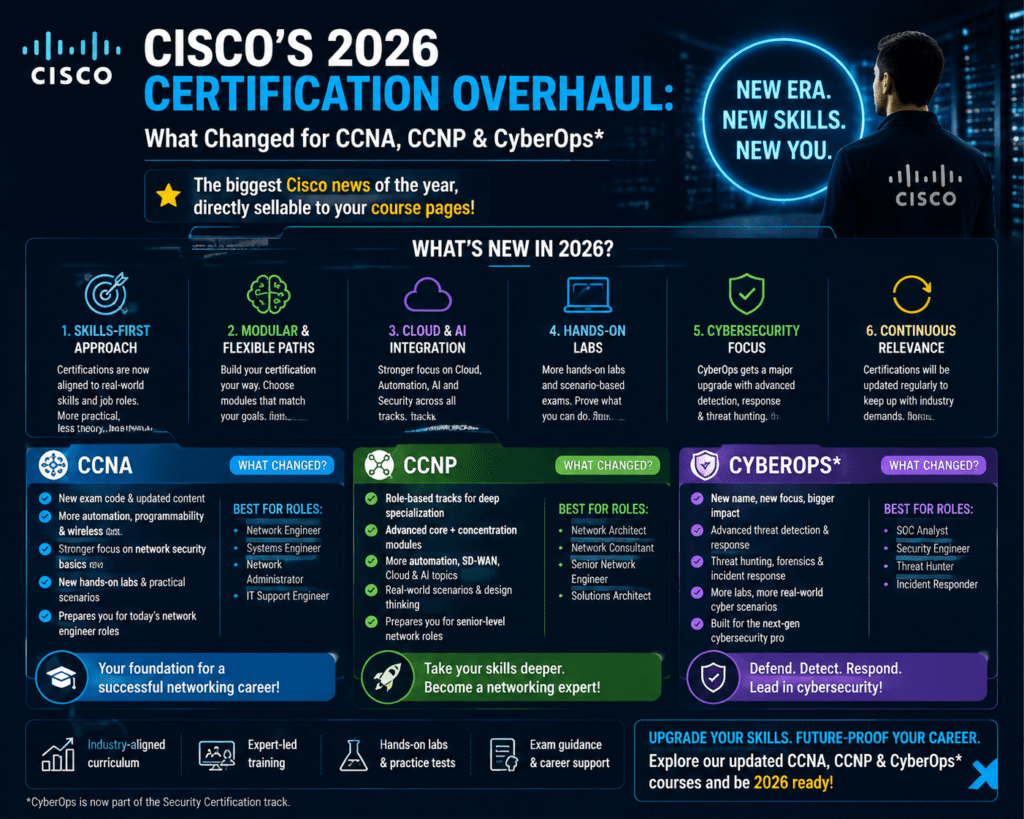
Cisco’s 2026 Certification Overhaul: What Changed for CCNA, CCNP & CyberOps?
The Cisco certification changes 2026 are some of the biggest changes Cisco learners have seen in years. But there is also a lot of confusion around what actually changed.
Did Cisco replace CCNA? Is CyberOps gone? Has CCNP changed? What happened to DevNet? And should students who are already preparing for Cisco exams change their study plans?
The short answer is that Cisco has simplified its certification structure while putting much more focus on cybersecurity, automation, artificial intelligence, cloud technologies, and practical networking skills.
On February 3, 2026, Cisco officially brought its Automation and Cybersecurity certifications under the familiar CCNA, CCNP, and CCIE naming system. DevNet certifications became Automation certifications, while CyberOps certifications moved under the CCNA and CCNP Cybersecurity brands.
For networking students and IT professionals, this is more than a branding exercise. It gives Cisco learners clearer career paths and shows where enterprise networking jobs are moving next.
What Exactly Changed in Cisco Certifications in 2026?
Cisco’s main goal was to make its certification paths easier to understand while aligning them with modern job roles.
The biggest changes effective February 3, 2026, were:
- DevNet Associate became CCNA Automation
- DevNet Professional evolved into CCNP Automation
- DevNet Expert became CCIE Automation
- CyberOps Associate became aligned under CCNA Cybersecurity
- CyberOps Professional became aligned under CCNP Cybersecurity
Cisco also confirmed that professionals holding active certifications affected by these changes would automatically receive recognition under the corresponding new certification names.
That means someone who already earned an active DevNet Associate certification did not suddenly lose their achievement. Cisco recognizes that credential as CCNA Automation under the new structure.
The same principle applies to eligible cybersecurity certification holders.
This creates a much simpler career ladder:
Associate → CCNA
Professional → CCNP
Expert → CCIE
The specialization then tells employers whether your expertise is in Enterprise networking, Automation, Cybersecurity, Security, Data Center, Collaboration, or another Cisco technology area.
Did the Regular CCNA Change in 2026?
This is where many students are getting confused.
The standard networking CCNA 200-301 did not get replaced on February 3, 2026.
Cisco’s current exam list still shows the traditional CCNA under its Enterprise track with exam 200-301 CCNA. The current exam tests networking fundamentals, network access, IP connectivity, IP services, security fundamentals, automation, and programmability.
So if you are currently preparing for the CCNA 200-301 exam in 2026, you do not need to abandon your preparation because of the February certification changes.
However, another important CCNA change is coming.
In May 2026, Cisco announced the first major redesign of the CCNA blueprint since 2019. The refreshed exam is scheduled to become available on February 3, 2027.
Cisco says the new blueprint will place stronger emphasis on four major areas:
- Network infrastructure
- Troubleshooting and problem-solving
- Security-first thinking
- AI in network management and operations
Cisco is also increasing the role of practical and experiential learning rather than relying only on theoretical knowledge.
That is an important signal for anyone planning a networking career.
Learning commands only to pass an exam will become less useful. Candidates need to understand why networks behave the way they do and how to diagnose real problems.
For beginners, structured CCNA training with routing, switching, subnetting, VLANs, IP services, security, troubleshooting, automation, and lab practice remains one of the strongest ways to build a networking foundation.
What Changed for CCNP in 2026?
The CCNP name itself has not disappeared. In fact, Cisco is expanding the value of the CCNP brand.
Current certifications include established paths such as CCNP Enterprise, CCNP Security, CCNP Data Center, CCNP Collaboration, and others. Cisco’s 2026 restructuring adds clearer Automation and Cybersecurity paths alongside them.
One of the biggest changes involves CCNP Automation.
The old DevNet Professional path was not simply given a new name. Cisco redesigned the professional-level Automation certification around the work modern network automation engineers actually perform.
The new CCNP Automation core focuses more heavily on areas such as:
- Network automation
- Infrastructure as Code
- Python
- Ansible
- Terraform
- CI/CD pipelines
- GitOps
- Digital twins
- Model-driven telemetry
- Network observability
- AI-assisted automation
Cisco specifically explained that the goal is to validate professionals who are network engineers with strong automation skills rather than application developers who happen to understand networking.
That distinction matters.
Enterprise networks are becoming too large and dynamic to manage every change manually. Network engineers who understand both traditional networking and automation can therefore build a much broader technical skill set.
For professionals who already understand routing and switching, moving from CCNA to CCNP training remains a logical progression for developing advanced enterprise networking and troubleshooting knowledge.
What Happened to Cisco CyberOps?
CyberOps has not disappeared as a career skill.
The certification branding changed.
Cisco’s associate-level cyber operations certification is now presented as CCNA Cybersecurity, while the professional path is aligned under CCNP Cybersecurity.
This may actually make the qualification easier for recruiters and employers to understand.
Someone seeing “CCNA Cybersecurity” immediately knows two things: the credential belongs to Cisco’s recognized associate-level family, and the specialization is cybersecurity.
The current associate exam is 200-201 CCNACBR v1.2 – Understanding Cisco Cybersecurity Operations Fundamentals.
According to Cisco, the exam covers areas including:
- Security concepts
- Security monitoring
- Host-based analysis
- Network intrusion analysis
- Security policies and procedures
Passing the exam currently earns the CCNA Cybersecurity certification.
These skills are particularly relevant for people targeting roles such as SOC Analyst, cybersecurity operations specialist, security analyst, or other entry-level defensive security positions.
Students who previously searched for Cisco CyberOps training should therefore understand that the skills are still relevant. The certification simply sits under the clearer CCNA Cybersecurity identity in Cisco’s current portfolio.
CCNP Cybersecurity Creates a Clearer Advanced Security Path
Cisco has also placed its professional cybersecurity path under the CCNP Cybersecurity name.
Candidates need a core exam and one concentration exam to earn the professional certification. Cisco currently lists areas such as cybersecurity operations, threat hunting, forensic analysis, and incident response within the professional track.
At this level, learners move beyond identifying basic threats.
They develop skills around investigating attacks, analysing security events, responding to incidents, securing systems, working with security data, and using automation to improve security operations.
This gives candidates a clearer progression:
CCNA Cybersecurity → CCNP Cybersecurity
For someone planning a long-term cybersecurity career, that path is easier to understand than several disconnected certification names.
Automation Is No Longer an Optional Networking Skill
One of the clearest messages behind Cisco’s 2026 changes is that networking and automation are becoming closely connected.
Cisco replaced the DevNet naming with:
CCNA Automation → CCNP Automation → CCIE Automation
The current Cisco exam catalogue lists CCNA Automation under exam 200-901 CCNAAUTO, while CCNP Automation uses the professional-level Automation structure headed by 350-901 AUTOCOR.
For students, this means Python, APIs, Infrastructure as Code, configuration automation, telemetry, and AI-assisted networking are becoming increasingly useful additions to traditional routing and switching knowledge.
You do not need to become a full-time software developer.
But a modern network engineer should increasingly understand how software can configure, monitor, troubleshoot, and manage infrastructure at scale.
Why Is Cisco Making These Changes?
Cisco’s certification overhaul reflects how infrastructure jobs themselves are changing.
A network is no longer only routers, switches, VLANs, and routing protocols.
Modern environments can include:
- On-premises infrastructure
- Public and private cloud
- Software-defined networking
- Network automation
- Cybersecurity controls
- APIs
- Infrastructure as Code
- AI-assisted network operations
- Continuous monitoring and observability
Cisco says its certification updates are intended to prepare learners for AI, automation, cloud, cybersecurity, and increasingly complex hybrid environments.
That is why practical skills matter more than ever.
Knowing an OSPF definition is useful.
Being able to configure OSPF, recognize why a neighbour relationship failed, inspect the network, isolate the problem, and restore connectivity is far more valuable.
The same applies to cybersecurity and automation.
Which Cisco Certification Should You Choose in 2026?
The best path depends on the job you want.
Choose CCNA if you are new to networking
If you are a fresher, student, support engineer, or IT professional moving into networking, CCNA remains an excellent foundation.
Build strong knowledge of IP addressing, subnetting, switching, routing, wireless networking, security, automation, and troubleshooting.
Networkers Champ’s current CCNA training offering focuses on hands-on labs, real network scenarios, classroom and online learning, and career-oriented preparation.
Suggested internal anchor: CCNA Training in Bangalore
Choose CCNP if you already understand networking fundamentals
CCNP is more suitable when you want deeper enterprise networking knowledge and more advanced technical roles.
Networkers Champ currently provides CCNP training across Enterprise, Security, Data Center, Service Provider, and Collaboration technologies, with practical learning and multiple training modes.
Suggested internal anchor: CCNP Training in Bangalore
Choose CCNA Cybersecurity if you want a SOC or defensive security career
If your goal is security monitoring, threat detection, incident investigation, or SOC operations, the newly branded CCNA Cybersecurity path is highly relevant.
Networkers Champ’s CyberOps training already focuses on monitoring networks, identifying security threats, analysing attacks, responding to incidents, and preparing learners for SOC-oriented cybersecurity roles.
Suggested internal anchor: CCNA CyberOps Training
Choose Automation if you enjoy networking and programming
If you already understand networks but want to work with APIs, Python, automation frameworks, Infrastructure as Code, or AI-driven network operations, Cisco’s Automation certification path deserves serious attention.
It represents one of the clearest directions Cisco is taking its certification ecosystem.
What Should Existing Cisco Students Do Now?
Do not panic and restart your preparation simply because certification names changed.
Instead:
- Confirm the exact Cisco exam you plan to take.
- Download the latest official exam blueprint.
- Check the exam version before choosing study materials.
- Spend more time on practical labs.
- Build troubleshooting ability instead of memorizing answers.
- Add basic security and automation knowledge to your networking skills.
- Follow Cisco’s certification roadmap for upcoming exam updates.
If you are preparing for the existing CCNA 200-301 during 2026, Cisco has specifically said there is no reason to change course purely because its refreshed CCNA exam arrives in February 2027.
Final Thoughts: Cisco Certifications Are Becoming More Job-Focused
The Cisco certification changes 2026 are not simply about renaming certificates.
They show where networking careers are moving.
Traditional networking remains important. But Cisco is increasingly connecting networking with cybersecurity, automation, AI, cloud infrastructure, programmability, and practical troubleshooting.
CCNA continues to provide the core networking foundation. CCNP provides deeper professional-level specialization. CyberOps now has the stronger CCNA Cybersecurity and CCNP Cybersecurity identity. DevNet has evolved into a clearly defined Automation certification path.
For learners, the message is simple: do not prepare only to pass an exam.
Build skills you can actually use.
Networkers Champ offers Cisco-focused training for learners moving from foundational CCNA skills toward CCNP, cybersecurity, automation, and advanced networking technologies, with practical lab-based learning available through its Bangalore and online training options.
If you are planning your Cisco certification journey in 2026, start with the career you want, select the certification path that supports it, and make practical experience a major part of your preparation.
FAQs About Cisco Certification Changes 2026
1. Did Cisco change CCNA in 2026?
The standard 200-301 CCNA was not replaced during the February 3, 2026 certification restructuring. Cisco has announced a major refreshed CCNA blueprint that is scheduled to go live on February 3, 2027.
2. Is Cisco CyberOps discontinued?
The CyberOps skill path continues, but Cisco has aligned its cybersecurity certifications under the CCNA and CCNP brands. The associate certification is now CCNA Cybersecurity.
3. What is the new name for DevNet Associate?
Cisco DevNet Associate transitioned to CCNA Automation on February 3, 2026.
4. What is CCNP Automation?
CCNP Automation is Cisco’s professional-level automation certification. It builds on the former DevNet Professional track but has been redesigned with greater emphasis on network automation, Infrastructure as Code, CI/CD, telemetry, modern automation tools, and AI.
5. Is CCNA still worth doing in 2026?
For people entering networking, infrastructure, NOC, cloud networking, security, or advanced Cisco technologies, CCNA remains Cisco’s core associate-level enterprise networking certification and provides an important foundation for more advanced learning.
6. Should I choose CCNA or CCNA Cybersecurity?
Choose CCNA if you want a broad networking foundation. Choose CCNA Cybersecurity if your main goal is security monitoring, threat analysis, incident response, or SOC-related work. Candidates who understand both networking and cybersecurity can also build the skills progressively.